
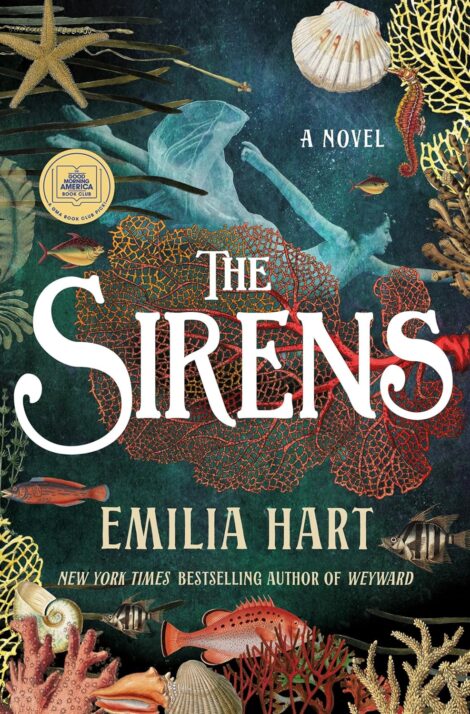
THE SIRENS
INSTANT NEW YORK TIMES BESTSELLER • A GOOD MORNING AMERICA BOOK CLUB PICK • #1 LibraryReads Pick • Indie Next Pick
A spellbinding novel about sisters separated by centuries, but bound together by the sea, from the author of the runaway New York Times bestseller Weyward
2019: Lucy awakens from a dream to find her hands around her ex-lover’s throat. Horrified, she flees to her older sister’s house on the Australian coast, hoping she can help explain the strangely vivid nightmare that preceded the attack—but Jess is nowhere to be found.
INSTANT NEW YORK TIMES BESTSELLER • A GOOD MORNING AMERICA BOOK CLUB PICK • #1 LibraryReads Pick • Indie Next Pick
A spellbinding novel about sisters separated by centuries, but bound together by the sea, from the author of the runaway New York Times bestseller Weyward
2019: Lucy awakens from a dream to find her hands around her ex-lover’s throat. Horrified, she flees to her older sister’s house on the Australian coast, hoping she can help explain the strangely vivid nightmare that preceded the attack—but Jess is nowhere to be found.
As Lucy awaits her return, the rumors surrounding Jess’s strange small town start to emerge. Numerous men have gone missing at sea, spread over decades. A tiny baby was found hidden in a cave. And sailors tell of hearing women’s voices on the waves. Desperate for answers, Lucy finds and begins to read her sister’s adolescent diary.
1999: Jess is a lonely sixteen-year-old in a rural town in the middle of the continent. Diagnosed with a rare allergy to water, she has always felt different, until her young, charming art teacher takes an interest in her drawings, seeing a power and maturity in them—and in her—that no one else has.
1800: Twin sisters Mary and Eliza have been torn from their loving father in Ireland and forced onto a convict ship bound for Australia. For their entire lives, they’ve feared the ocean, as their mother tragically drowned when they were just girls. Yet as the boat bears them further and further from all they know, they begin to notice changes in their bodies that they can’t explain, and they feel the sea beginning to call to them…
A breathtaking tale of female resilience and the bonds of sisterhood across time and space, The Sirens captures the power of dreams, and the mystery and magic of the sea.
- St. Martin's Press
- Hardcover
- April 2025
- 368 Pages
- 9781250280824
Buy the Book
$29.00

- St. Martin's Griffin
- Paperback
- February 2026
- 368 Pages
- 9781250842732
Buy the Book
$19.00
About Emilia Hart
Emilia Hart is the author of Weyward and The Sirens. She grew up in Australia and studied English Literature at university before training as a lawyer. She now lives in London.
Praise
“Some novels don’t just tell a story; they sing. The Sirens is one of them—a lyrical, evocative tale that sweeps you into the salty winds of the Irish and Australian coasts, weaving together history, myth and the unbreakable resilience of women…Hart has a gift for crafting complex, unforgettable female characters [and] each woman’s story feels both deeply personal and universally resonant, a testament to Hart’s ability to infuse historical fiction with raw emotional depth…If you love stories that interlace historical depth with rich, almost magical prose—think Kate Morton meets Alice Hoffman—The Sirens is a must-read. Haunting, beautifully crafted and fiercely empowering, it will leave you listening for echoes of its melody long after you’ve turned the last page.” —BookTrib
“Entertaining. Hart (Weyward) delivers a high-voltage tale of family secrets, fantastical occurrences, and Australian history.” —Publishers Weekly
“Haunting, immersive and deeply alive, The Sirens feels as storied and ancient as the myths it explores, a true classic-in-the-making work of feminist fire and fury….Hart is a truly gifted, spellbinding author.” —Bookreporter
“The Sirens entices us with the combination of mesmerising beauty mixed with mortal danger. Hart skillfully entwines mystical aspects into what could be construed as part-fairytale, but its multiple timeframes and historical settings are firmly grounded.” —Historical Novel Society
“Hart’s second novel (after Weyward) weaves a lyrical story, intricately blending family dynamics with the magic of folklore. For fans of family relationship stories with elements of magical realism, such as the novels of Sarah Addison Allen.” —Library Journal
Discussion Questions
1. Mary, Eliza, Jess, and Lucy are separated by more than two hundred years, and yet they are closely aligned throughout the novel. What experiences do they share, and what does this suggest about feminine struggles across generations? How do their experiences also differ?
2. “[The sea] was gray and furious, lapping at the rocks as if it would eat the land.” (page 22) Discuss the ocean as a character and how, by the end, Mary considered it “a female world.” (page 314) Consider the kinds of events that took place on land or ship, as opposed to underwater. Similarly, how do the power dynamics between men and women shift between land and sea? Why do you think Mary referred to the ocean as feminine?
3. Lucy’s and Jess’s sleepwalking makes them feel like they lack control of their bodies at times. How does this relate to the various sexual assault scenarios mentioned in the story?
4. Once Mary and Lucy decide to embrace what makes them unique and give in to the ocean’s call, their “otherness” quite literally saves lives. What do you think this element of the plot suggests about the power of self-love and acceptance, and its ripple effects?
5. Consider Lucy’s interest in true crime podcasts. Do you find yourself similarly drawn to this type of storytelling? What do you think this novel ultimately has to say about the capacity for any kind of investigative reporting to identify the truth? How might the facts of a case differ from the truth of it?
6. As a result of directly experiencing the failed justice system as a woman, Lucy became aware of her power. “Freed from her prior inhibitions—from the compulsion to be nice, to be a good girl—she’d become something she could never have imagined. She’d become . . . dangerous.” (page 126) What female traits and behaviors could lead her to be deemed dangerous? How are Jess, Mary, and Eliza also perceived as dangerous by the men in their lives?