
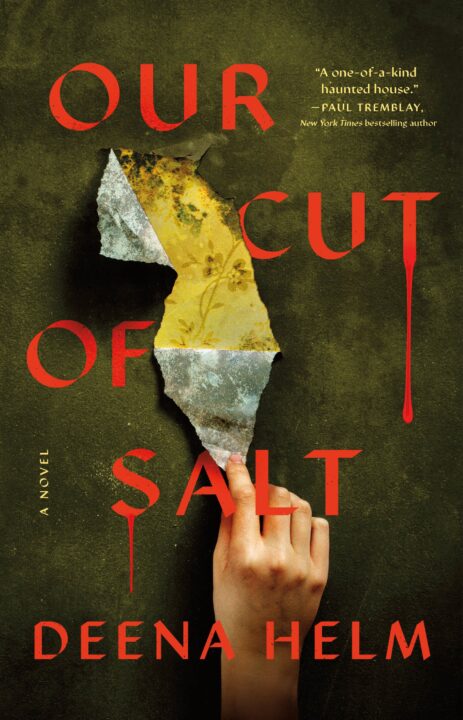
OUR CUT OF SALT
There is something haunting Nuhad’s childhood home in Haifa. Cats avoid its perimeter, strange noises come from within, and residents have mysteriously vanished without a trace. Although Nuhad has not returned to her home since the Nakba in 1948, she always held a place for the house in her heart.
And, in return, the house did the same for her.
After Nuhad passes away, her granddaughter, Marina, is determined to visit her grandmother’s home after a lifetime of being kept in the dark about her culture and family history. Marina’s mother, Haifa—named for the city that was lost to their family—reluctantly agrees to her trip,
There is something haunting Nuhad’s childhood home in Haifa. Cats avoid its perimeter, strange noises come from within, and residents have mysteriously vanished without a trace. Although Nuhad has not returned to her home since the Nakba in 1948, she always held a place for the house in her heart.
And, in return, the house did the same for her.
After Nuhad passes away, her granddaughter, Marina, is determined to visit her grandmother’s home after a lifetime of being kept in the dark about her culture and family history. Marina’s mother, Haifa—named for the city that was lost to their family—reluctantly agrees to her trip, though she knows firsthand that some secrets are better left buried.
But the house is no longer a home. It is a painful, festering wound that infects everything it touches. The more Marina digs into her family’s past, the sicker she becomes. Despite Nuhad’s ghostly warnings, Haifa rushes to help her daughter.
As the three women converge in their ancestral home, they must put the haunting to rest before the secrets of the past drown them all.
- Tor Nightfire
- Paperback
- September 2026
- 288 Pages
- 9781250434661
Buy the Book
$27.99

About Deena Helm

Deena Helm is a mixed Palestinian-American author, and Our Cut of Salt is her debut novel. Her other works can be found in Fikra Magazine and So To Speak. She asks that you, the reader, do everything in your power to resist genocide and deepen your commitment to liberation for all.
Praise
“Lyrical and haunting, Our Cut of Salt explores the horrors of occupation via the lens of three generations of women as well as a one-of-a-kind haunted house. A disturbing, mesmerizing read.”—Paul Tremblay, New York Times bestselling author of Dead but Dreaming of Electric Sheep
“Our Cut of Salt redefines the haunted house in the context of haunted history. Part Gothic horror, part family portrait, this is a haunting, gut-wrenching testament to the resilience of memory and the ghosts that survive through and alongside us.”—Hala Alyan, author of Salt Houses
“A beautifully crafted reminder that the greatest horrors often come from the actions of humans.”—Publishers Weekly, starred review
“Deeply human…. The essential haunted house story of our moment in history. A gorgeous and painful debut.”—Gretchen Felker-Martin, USA Today bestselling author of Black Flame
Discussion Questions
- Home is a recurring theme throughout Our Cut of Salt. Share what home means to each generation of Sayadi women: Marina, Haifa, and Nuhad. What does home mean to you? Has your meaning of home changed over time? If so, how?
- As a college student, Marina feels compelled to travel to Palestine to find answers about her family, living and dead. Did you support her decision? Has there ever been a time where you researched family history? How did you approach it? What was the result?
- Once she arrives in Palestine, Marina notices everyone advises her to stay away from her ancestral home. Why do you think that is? What would you have done if you were in her situation? Explain your decision.
- Haifa residents see mysterious things happen to occupants to the Sayadi house, such as residents experiencing strange noises, seeing odd visions, or even disappearing entirely. Do you believe the house in Haifa is haunted? Why or why not?
- Eventually, Marina decides to seek out answers from Rania, a longtime family friend of Nuhad. What was your first impression of Rania? What was your lasting impression? Describe her influence on Nuhad and the Sayadi family.
- What was your reaction to Marina visiting the house in Haifa for the first time? Why did Marina feel compelled to visit her ancestral house, even after others, including her own family, warned her to leave the past behind?
- As the story continues, chapters alternate between past and present. What was your response to Nuhad sharing her childhood memories? How do you think Nuhad felt watching Marina visit their homeland?
- Over the course of several chapters, Marina and Haifa discover Nuhad’s childhood journals, which are filled with old secrets. How did you respond to Nuhad’s memories? What stood out to you the most from her journals? Why?
- Marina grows increasingly sick as she uncovers the house’s secrets. Rania and her son, Khaled, become a newfound family while Marina recovers. Has there been a person(s) in your life that you consider to be chosen or found family? How have they supported you in times of need?
- Marina’s ongoing discoveries shed insight into the lives of Basel and Victoria. Explain their significance. Why was Marina drawn to their story? How did their story fill in the gaps of Sayadi family history?
- Tariq is found to be a central person within the Sayadi family. Why was his existence kept secret for so long? Why does Nuhad feel guilty about what happened to Tariq? In your words, what is the importance of sharing Tariq’s story with the wider world?
- Salt is an essential item to each generation of Sayadi women. Recount the various ways they have used salt in each of their lives. Is there an object that you have used to find solace? If so, how has that item brought your comfort?
- What was your response to Marina and Haifa’s decision at the end of Our Cut of Salt? What would you have done if you were in their situation? Is the house in Haifa still haunted? Why or why not?