
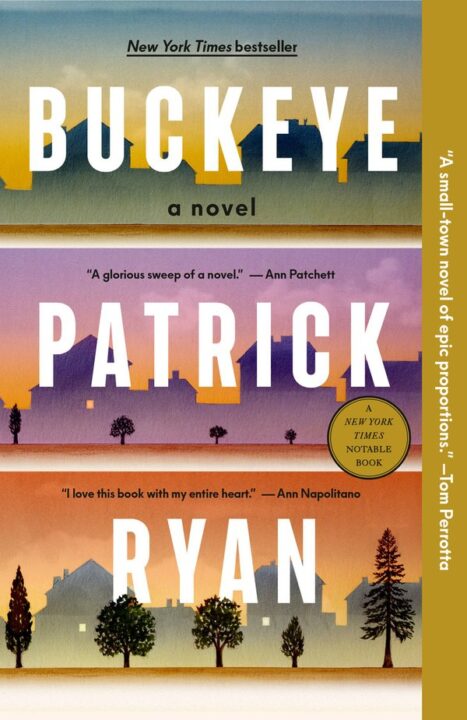
BUCKEYE
NEW YORK TIMES BESTSELLER • READ WITH JENNA BOOK CLUB PICK AS FEATURED ON TODAY • “A glorious sweep of a novel” (Ann Patchett) that weaves the intimate lives of two midwestern families across generations, from World War II to the late twentieth century.
“Mesmerizing.”—People
“Captivating.”—The New York Times Book Review
“A once-in-a-decade novel . . . I fell in love with these characters.”—Jenna Bush Hager
ONE OF THE BEST BOOKS OF THE YEAR: The New York Times Book Review, The Washington Post,
NEW YORK TIMES BESTSELLER • READ WITH JENNA BOOK CLUB PICK AS FEATURED ON TODAY • “A glorious sweep of a novel” (Ann Patchett) that weaves the intimate lives of two midwestern families across generations, from World War II to the late twentieth century.
“Mesmerizing.”—People
“Captivating.”—The New York Times Book Review
“A once-in-a-decade novel . . . I fell in love with these characters.”—Jenna Bush Hager
ONE OF THE BEST BOOKS OF THE YEAR: The New York Times Book Review, The Washington Post, NPR, People, Minnesota Star Tribune, New York Post, Chicago Public Library
FINALIST FOR THE OHIO BOOK AWARD • LONGLISTED FOR THE JOYCE CAROL OATES PRIZE AND THE MARK TWAIN AMERICAN VOICE IN LITERATURE AWARD
****
That, as he saw it now, was his life’s work: trying to make right what he’d gotten wrong. Wasn’t that a fair measure of a person, what they did with their mistakes?
In the jubilant aftermath of the Allied victory in Europe, Cal Jenkins, a man wounded not in war but by his inability to serve in it, shares a single, life-altering moment with Margaret Salt, a woman determined to outrun her past. Cal is married to Becky, whose spiritual gifts help the living speak to the dead, while Margaret’s husband, Felix, is serving at sea, believed to be safe—until a telegram suggests otherwise.
What begins as a fleeting transgression becomes a complex secret that irrevocably binds all four of them in unexpected ways. As their small Ohio town remakes itself in the postwar boom, the Salt and Jenkins families remain in each other’s orbit, and the consequences of choices made long ago begin to emerge, reshaping their lives in ways that will forever impact the next generation.
Sweeping yet intimate, resplendent with moments of deep emotion and unforgettable characters, Buckeye is a transportive story of love, loyalty, sacrifice, and forgiveness.
- Random House Trade Paperbacks
- Paperback
- September 2026
- 9780593595053
Buy the Book
$20.00

About Patrick Ryan
Patrick Ryan is the author of the story collections The Dream Life of Astronauts (named one of the Best Books of the Year by the St. Louis Times-Dispatch, Literary Hub, Refinery29, and Electric Literature, and longlisted for The Story Prize) and Send Me. His work has appeared in The Best American Short Stories, the anthology Tales of Two Cities, and elsewhere. The former associate editor of Granta, he is the current editor-in-chief of the literary magazine One Story. He lives in New York City.
Praise
“[A] luminous and tender 20th-century saga of wounded souls and small-town secrets.”—The Guardian
“Enhanced with a hazy sentimentality, Ryan’s quiet drama conjures moral complexities behind the facade of carefully crafted mid-century lives.”—The Washington Post
“This mesmerizing, tender novel follows two Ohio families from the 1920s through the ‘60s as they find and lose love and loved ones through what one character aptly calls ‘the unraveling of time.’”—People
“Well-crafted and poignant . . . Buckeye draws the reader into its time and place and simply beguiles. This chronicle of leaving and loss, loving and forgiving, burns slowly and hopefully until the end.”—BookPage
“Buckeye is a thing of wonder. It’s my book of the year. I couldn’t love it more.”—Chris Whitaker, New York Times bestselling author of All the Colors of the Dark
“Buckeye offers just about everything I look for in a great story: a vivid setting, historical sweep, rich characters who break your heart even as they make you laugh and all of this in abundance.”—Richard Russo, author of Empire Falls and the North Bath trilogy
“Heartfelt and at times harrowing, Buckeye is both an absorbing portrait of an American past and a sympathetic exploration of what continues to sustain us and to plague us.”—Alice McDermott, author of Absolution
“I’ve been yearning for a novel that connects the American generations who dealt with our two wars—one of Omaha Beach, the other of the la Drang Valley. Buckeye is that book, and it soars.”—Tom Hanks
“Patrick Ryan conjures a vanished America with uncanny skill and writes with deep insight and lyrical intelligence…This is a novel to settle in with, a world unto itself.”—Tom Perrotta, author of Little Children
“A deeply compassionate book . . . Patrick Ryan tells a story we very much need right now: how forgiveness might creep up—despite everything—over time, tender and elusive and ever-complex.”—Emily Fridlund, author of History of Wolves
“Patrick Ryan has created a world, and characters, that exist inside me now, and as a reader that is my deepest joy. I could not recommend this book more highly.”—Ann Napolitano, author of Hello Beautiful
“Patrick Ryan has long been one of my favorite writers. I have a feeling that with this book he’s going to be everyone’s favorite writer.”—Ann Patchett
“Filled with wit and emotion on every page, this is a stirring paean to the joys and sorrows of family.”—Publishers Weekly, starred review
“[A] tale that comes across as absolutely authentic and deeply satisfying.”—Booklist, starred review
Discussion Questions
- Cal’s limp keeps him home during WWII, a detail that shapes his whole sense of identity. How does his feeling of being “left behind” echo through his marriage, his work, and his parenting, later on?
- Becky’s connection to the dead makes her both respected and ridiculed in Bonhomie. What does Ryan seem to be saying about women who hold unconventional power in small towns?
- Margaret begins the novel as an infant left at an orphanage in 1918. How does that early abandonment and the fact that she never gets adopted influence her adult choices—particularly her affair and her parenting of Tom?
- Felix and Augie’s love story unfolds in shadows. How does Ryan depict queer love with both dignity and tragedy?
- Bonhomie itself feels alive—a place built from immigrant labor, factory work, and memory. How does the town change from the 1940s to the 1970s, and what does it preserve?
- Skip and Tom’s friendship bridges two families. What do their differences—and their bond—reveal about class, parenting, and legacy in Bonhomie?
- After Skip’s death, Becky waits to hear from him. How does her eventual contact with Skip reframe the book’s ideas about grief and forgiveness?
- Cal and Becky’s marriage endures betrayal and silence. How does Ryan portray forgiveness not as a resolution but as lifelong work?
- Ida and Becky’s late-life conversation about marriage and regret (the “bridge” metaphor) shows two generations facing the same question: what makes staying with a less-than-ideal partner worth it? Do you agree with their conclusions?
- Tom grows up surrounded by half-truths. By the time he hosts The Salt Mine on local radio, what kind of truth is he seeking—personal, moral, or communal?
- The “Zane Grey Boys” reading group becomes a small but vital act of connection for some of Bonhomie’s senior citizens. Why do you think Ryan includes this scene of male friendship-through-books in a story so concerned with silence?
- Work defines nearly every character—from hardware clerks to factory foremen. How does Ryan use labor to explore identity, pride, and belonging in mid-century America?
- Several characters wrestle with inheritance—emotional and material. What do the next generations (Tom, Kathy) carry forward, and what do they consciously reject?
- If you had the opportunity to contact a lost loved one through Becky, would you do it? Who would you contact and what would you say?