
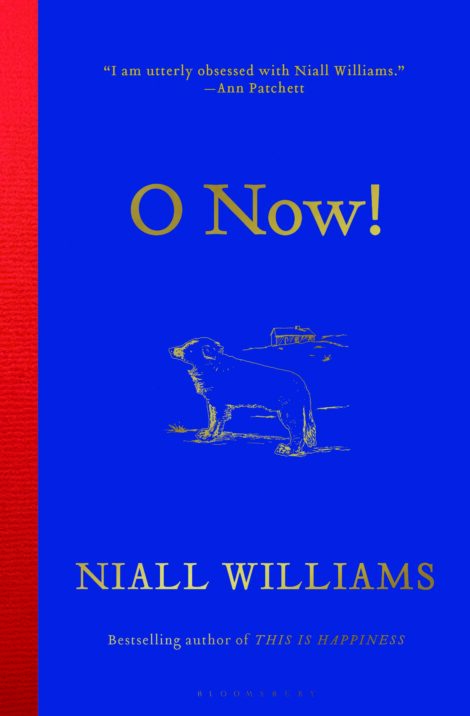
O NOW!
From novelist Niall Williams, bestselling author of Time of the Child and This Is Happiness, a new story set in the small Irish town of Faha, exploring love, loss, and the “why” of life.
Mossie Crowe, known as “Ganga,” is that rare man who is beloved by everyone who knows him and is particularly cherished by his best friend, Bat. On one ordinary October day, Bat interrupts their usual evening tea to ask Ganga why God created the earth. But when Ganga passes away that night, Bat finds himself at a loss,
From novelist Niall Williams, bestselling author of Time of the Child and This Is Happiness, a new story set in the small Irish town of Faha, exploring love, loss, and the “why” of life.
Mossie Crowe, known as “Ganga,” is that rare man who is beloved by everyone who knows him and is particularly cherished by his best friend, Bat. On one ordinary October day, Bat interrupts their usual evening tea to ask Ganga why God created the earth. But when Ganga passes away that night, Bat finds himself at a loss, without his friend and without an answer to his question. Over the next days, as all of Faha comes to care for and honor the body of the man they loved, Bat begins a new journey towards understanding life, death, and love.
A tender exploration of life’s many meanings, O Now! is a perfect gift for readers who loved Niall Williams’ previous Faha novels and features an all-new essay from Niall exploring Faha’s creation and legacy.
- Bloomsbury Publishing
- Hardcover
- November 2026
- 96 Pages
- 9781639739530
Buy the Book
$16.99

About Niall Williams

Niall Williams was born in Dublin. He is the author of eleven novels, including History of the Rain, which was longlisted for the Booker Prize, Four Letters of Love, which is now a major motion picture, This Is Happiness, which was shortlisted for the Irish Book Awards Book of the Year and longlisted for the Walter Scott Prize, and Time of the Child. He lives in Kiltumper in County Clare, Ireland.
Praise
“I am utterly obsessed with Niall Williams.” —Ann Patchett, New York Times bestselling author of Tom Lake
“In this shimmering jewel of a novella, the canny and perceptive Williams offers a quiet, lyrical, deeply satisfying contemplation of life’s deepest riddles. In three previous novels, Williams has lured legions of readers to Faha and its country lanes. A companion essay reveals that while Faha is a world thoroughly of his imagination, it’s also as real as any place that can be pinpointed on a map.” —Booklist, starred review
“A short story of surpassing sweetness… Williams’ sentences are so lilting they almost scan as poetry… This uplifting reading experience could provide an effective emergency rescue for your next bad mood or dark day.” —Kirkus Reviews, starred review
“This novella revisits the charming Irish village of Faha with its quirky cast of characters. The delightful bonus for Williams’s fans is the second half of this slim volume: a personal essay in which Willliams describes aspects of his writing life, how he came to create Faha, and how dear the characters are to him.” —Library Journal
Discussion Questions
1. Bat Considine and Mossie “Ganga” Crowe share a friendship built largely on routine, comfortable silences, and small gestures rather than meaningful conversations. What do their visits reveal about the depth of their relationship? How does Williams convey affection between two men who rarely express their feelings directly?
2. Ganga’s characteristic response, “O Now!”, gives the story its title. What does this simple expression communicate throughout the story? How does its meaning change, or take on greater significance, as the narrative unfolds?
3. Bat’s curiosity about God, the afterlife, and the meaning of existence leads him to propose an unusual arrangement with Ganga. What does this conversation reveal about Bat’s character and his understanding of mortality? Why might he choose Ganga as the person with whom to explore these questions?
4. When Bat discovers Ganga’s body, he doesn’t immediately alert anyone. Instead, he tends to Joe and settles in to wait for a sign from his friend. How do you interpret Bat’s response to Ganga’s death? What does his vigil reveal about his grief, his faith, and his relationship with Ganga?
5. Williams incorporates considerable humor into a story about death, particularly in the scene where Bat and Mrs. Crowley attempt to move Ganga’s body. How does this sometimes uncomfortable humor affect the tone of the story? What does it suggest about the author’s approach to mortality and the rituals surrounding death?
6. Mrs. Crowley emerges as a quietly important figure, taking charge of the practical arrangements following Ganga’s death while also looking after Bat. What do her actions reveal about her character? How does her relationship with Bat develop over the course of the story?
7. As news of Ganga’s death spreads, the people of Faha gather to pay their respects and share stories about him. How does this communal response deepen our understanding of Ganga, whose own voice is largely absent from the narrative? What role does the community play in shaping the story’s exploration of grief and remembrance?
8. Bat spends much of the story waiting for Ganga to fulfill their arrangement and reveal the mysteries of existence. Yet his eventual revelation comes not from a supernatural sign, but from listening to the people gathered at Ganga’s wake. What leads Bat to declare, “We’re made for love”? In what sense does this realization answer the questions that have troubled him?
9. The story ends with the suggestion of an unexpected romance between Bat and Mrs. Crowley. How does this possibility reflect the story’s larger themes of love, companionship, and human connection? What significance does it have that Bat’s understanding of love emerges through the loss of his closest friend?
10. In the accompanying essay, Williams describes his writing process as beginning with a single sentence and allowing the story to find its own direction, much like traveling the winding back roads of Ireland. How is this approach reflected in the structure and pacing of O Now!? What does the story gain from its seemingly unhurried, meandering narrative?
11. Williams explains that Faha began as a fictional setting for one story but became a place he wanted to revisit, populated by characters whose lives continued to inspire him. How does Faha function as more than simply a backdrop in O Now!? What does Williams’s observation that readers can find Faha only within the pages of a book suggest about the relationship between storytelling, place, and the imagination?