
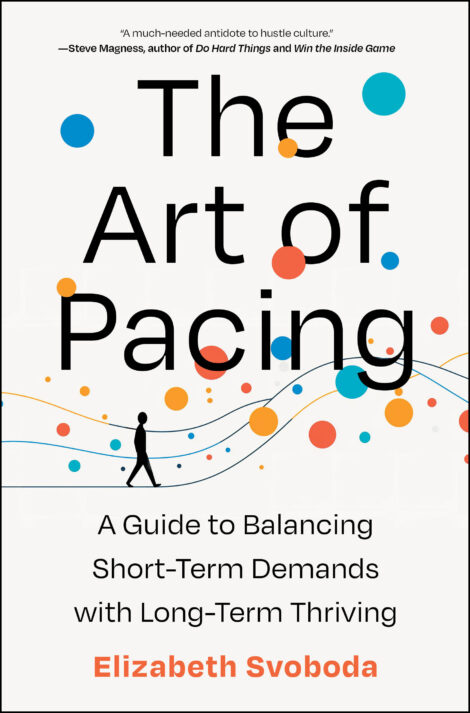
THE ART OF PACING
A guide to balancing hustle and leisure so you can make meaningful progress on what matters most, without burning out.
Many of us struggle to live a well-paced life and find ourselves perpetually oscillating between two extremes: intense effort and lethargy. At one extreme, we jump headfirst into big, critical projects, only to end up burned out. At the other extreme, we get sucked into black holes of social media scrolling and Netflix binging and fall far behind on our goals.
Science writer Elizabeth Svoboda’s The Art of Pacing explores how navigating the full range of the pace spectrum,
A guide to balancing hustle and leisure so you can make meaningful progress on what matters most, without burning out.
Many of us struggle to live a well-paced life and find ourselves perpetually oscillating between two extremes: intense effort and lethargy. At one extreme, we jump headfirst into big, critical projects, only to end up burned out. At the other extreme, we get sucked into black holes of social media scrolling and Netflix binging and fall far behind on our goals.
Science writer Elizabeth Svoboda’s The Art of Pacing explores how navigating the full range of the pace spectrum, not just the furthest ends, can transform the way you reach your goals. Blending memoir, cutting-edge psychology research, and interviews with Olympic athletes and entrepreneurs, Svoboda artfully uncovers the nuances of pacing so you can effectively balance ambition and rest, making subtle pace adjustments with ease.
- Simon Element / Simon Acumen
- Hardcover
- June 2026
- 240 Pages
- 9781668022412
Buy the Book
$29.00

About Elizabeth Svoboda
 Elizabeth Svoboda is an award-winning science writer and contributor to Scientific American, Discover, The Boston Globe, The New York Times, and other publications. Elizabeth is a winner of the Evert Clark/Seth Payne Award for Young Science Writers, and her work has been anthologized in the Best American Science and Nature Writing series. She lives in San Jose, California, with her husband and young sons.
Praise
“Every runner knows the danger of going out too fast. Managing your pace is the key to fulfilling your potential. The Art of Pacing shows us how that same principle governs work, relationships, and life itself. This book is a much-needed antidote to hustle culture, which has left many of us burned out or disengaged. Svoboda expertly draws on science, sport, and real-world stories to argue that the path to a meaningful life isn’t about going harder. It’s about going wiser.” —Steve Magness, author of Do Hard Things and Win the Inside Game
“The Art of Pacing is a wise and welcome antidote to hustle culture. Blending science, research, and storytelling, Svoboda makes a compelling case that the secret to thriving in the modern world is not to speed everything up or slow it all down. It’s to find the right pace—for the task, the moment, the life you wish to lead. Because mastering the art of pacing is how you master the art of living.” —Carl Honoré, author of In Praise of Slowness
“Engaging and deeply reported, The Art of Pacing is essential reading for anyone who seeks to work hard without burning out.” —Olga Khazan, author of Me, But Better
“At a moment when speed is often mistaken for progress, Svoboda shows that pacing isn’t a luxury—it’s a prerequisite for doing meaningful work in the long run. This book is a salve for a world that has forgotten how to slow down.” —Simone Stolzoff, author of The Good Enough Job and How To Not Know
“The Art of Pacing names the lie at the heart of modern ambition: that your only choices are burnout or disengagement. Svoboda offers a smarter, saner, science-backed alternative to grind culture—a way to move through life with intention, energy, and staying power by finding your right pace. Grounded in interdisciplinary research, this practical, approachable guide to flourishing is essential reading for anyone who wants to contribute meaningfully yet sustainably, without sacrificing themselves in the process.” —Megan Hellerer, author of Directional Living
Discussion Questions
- The Art of Pacing opens with the metaphor of a race pacer preventing runners from sabotaging themselves. In what ways do you find yourself “going out too fast” in your everyday life?
- Svoboda outlines a burnout cycle of overwork followed by collapse and disengagement. Have you found yourself caught in this cycle? What pacing tactics could you try to get yourself out of it?
- The Art of Pacing describes a strategy called “energy management”: aligning your most intense and demanding work with your natural energetic peaks during the day. How could you start to incorporate energy management into your own daily pacing plan?
- The book argues that pacing is not just an individual venture, but a collective one. How does pacing yourself become more challenging in a broader environment that doesn’t support it? Conversely, how can more nurturing settings support people’s efforts to pace themselves?
- Svoboda discusses the idea of “selective mediocrity,” which challenges conventional ambition. Do you believe that intentionally doing some things less well can ever lead to better outcomes? Why or why not?