
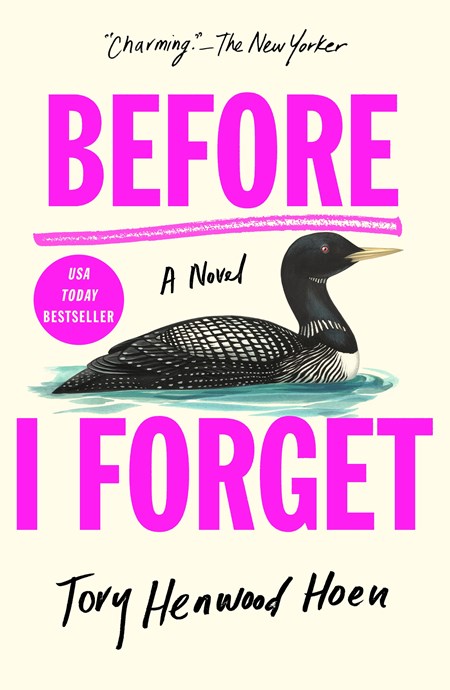
BEFORE I FORGET
Call it inertia. Call it a quarter-life crisis. Whatever you call it, Cricket Campbell is stuck. Despite working at a zeitgeisty wellness company, the 26-year-old feels anything but well. Still adrift after a tragedy that upended her world a decade ago, she has entered early adulthood under the weight of a new burden: her father’s Alzheimer’s diagnosis.
When Cricket’s older sister Nina announces it is time to move Arthur from his beloved Adirondack lake house into a memory-care facility, Cricket has a better idea. In returning home to become her father’s caretaker, she hopes to repair their strained relationship and shake herself out of her perma-funk.
As Cricket settles back into life at Catwood Pond—a place she once loved, but hasn’t visited since she was a teenager—she discovers that her father possesses a rare gift: as he loses his grasp of the past, he is increasingly able to predict the future. Before long, Arthur cements his reputation as an unlikely oracle, but for Cricket, believing in her father’s prophecies might also mean facing the most painful parts of her history. As she begins to remember who she once was, she uncovers a vital truth: the path forward often starts by going back.
With laugh-out-loud humor and profound grace, Before I Forget explores the nuances of family, the complexities of memory, and how sometimes, the people we know the best are the ones who surprise us the most.
- St. Martin's Press
- Hardcover
- December 2025
- 288 Pages
- 9781250276797
Buy the Book
$29.00

About Tory Henwood Hoen
TORY HENWOOD HOEN is the author of The Arc and Before I Forget. Her writing has appeared in New York Magazine, Vogue, Condé Nast Traveler, and Bon Appétit, among other publications. She attended Brown University, and she currently lives in New England.
Praise
“At once a charming exploration of small-town life and a realistically heartbreaking depiction of Alzheimer’s disease.” —Kirkus (starred review)
“Hoen delivers an uplifting tale filled with wisdom, warmth, and the kind of raw emotion that will have readers laughing through their tears.” —Library Journal (starred review)
“This quietly charming narrative asks readers to reconsider who is caring for whom, and to ponder the illimitability of human connection.” —The New Yorker
“Hoen offers a lovely, entertaining bildungsroman about family, forgiveness, grief, and memory…Before I Forget is a novel brimming with both pragmatism and heart, clear-eyed about the sadness, joy, regret, and grace that accompany the kinds of hard decisions many of us have faced or will face one day.” —Chicago Review of Books
“A thought-provoking story of love, heartbreak and healing, Before I Forget by Tory Henwood Hoen introduces readers to Cricket Campbell: 26, aimless and suddenly the caretaker of a father with Alzheimer’s disease. This late-coming-of-age story unfolds with tenderness as she grapples with grief, heals old wounds and finds herself.” —Reader’s Digest
“One of the season’s most interesting setups…a kind of delayed coming-of-age turned quarter-life crisis…Hoen brings heart and humor to a story that asks big questions about memory, inertia, and maybe even causality itself.” —Goodreads
“Hoen crafts a moving tale of family, heartache, and the connections that endure.” —Booklist
“Hoen’s satire of social media and opportunism adds bite to the tender portrayal of a young woman watching a parent fade. This family drama is worth a look.” —Publishers Weekly
“I loved this magical book. Tory Henwood Hoen approaches Alzheimer’s with generosity, wonder, and tender-hearted storytelling. The result is an uplifting tale full of wisdom, healing, and deeply human, funny characters. When I got to the end, I had tears in my eyes and expansion in my heart.” —Rebecca Barry, author of Recipes for a Beautiful Life
“An emotional, tender, yet restorative read. What I liked most was that there wasn’t just a focus on the loss of memory but the gaining of something, too. A wonderful and necessary reminder that whilst life’s worst cases can take away, the same cases can also give.” —Jessica George, New York Times bestselling author of Maame
“Before I Forget is an endearing novel of charm and warmth, the characters so well-drawn that to say goodbye feels like a real loss. It’s a homecoming story written with wit, grace, and genuine heart, and I will remember it—and especially the ending, a perfect farewell—for a long, long time.” —Adam White, bestselling author of The Midcoast
“A tender, funny portrait of love in its myriad forms, Before I Forget cleverly examines the way memories can shape, challenge, and haunt us—but also inspire us to take charge of our own fates. Tory Henwood Hoen crafts a setting so vivid and sensory that you’ll be longing to spend a lazy summer in the Adirondacks.” —Mikki Brammer, bestselling author of The Collected Regrets of Clover
Discussion Questions
1. How do the flashbacks into Cricket’s past contribute to your understanding of her character in the present, and how do they shape your reading experience?
2. Discuss the evolution of Cricket and Nina’s relationship over the course of the novel. How does Cricket’s perspective of Nina correlate with her self-image for most of the story, and what are the effects of this? Compare and contrast their respective caregiving approach.
3. How does Before I Forget critique our culture’s obsession with monetization and profit versus intrinsic value and service? “[Cricket] was exhausted by the compulsion to monetize everything; to convert every glimmer of authenticity into a product; to scale small joys until they are so bloated that they wither and droop.” (page 218) Discuss the ethical implications of using advanced technology to immortalize Arthur for financial gain, and why you think Cricket did not want to profit from the oracle project.
4. Considering Gemma’s promotional content, how does social media contribute to generating a heightened interest in “wellness” products and instilling a sense of urgency and necessity around them? To what extent do you think it can be taken too far, if at all? How does society’s view on aging and beauty standards feed into this “wellness” obsession? What do you think people are truly seeking when they indulge in Extreme Wellness?
5. How does Gemma’s idea of self-care differ from Carl’s idea of it? What is something you turn to as a form of self-care?
6. Compare and contrast Locust and New York City. How does Cricket’s setting influence her character development? How do the pace and community dynamic differ in each location?
7. How is the Adirondacks house a main character within the novel, and how does it reflect broader themes of identity and change? How does the house reflect Arthur’s and Tish’s contrasting outlooks?
8. What do you make of the loons? Why do you think Cricket is so intrigued by the loonlet toward the end of the novel?
9. What does Cricket’s recurring dream, and its evolution, reveal to you about her internal state? Have you ever had a recurring dream?
10. Cricket and Arthur are both at pivotal yet opposite stages in their lives when they reunite. How do you think they each impacted the other’s sense of self during this crucial time, if at all? In what ways do you think Cricket might have been holding herself back, and how does Seth’s tragic accident shape Cricket’s sense of herself, and her relationships, for a decade? Have you ever felt defined by the stories you tell yourself?
11. “Since his diagnosis, my father’s social network has atrophied. People aren’t sure how to interact with him, so they just stop interacting at all.” (page 23) How does the fear of not knowing how to engage with a person who is ill lead them to social isolation? What are some steps an individual could take to ensure continued support and connection with an ailing friend or loved one?
12. Though Before I Forget addresses the challenges of caretaking and memory loss, it also considers the opportunity to shift perspectives—in this case, Cricket appreciates Arthur’s newfound ability to connect with his intuition without the weight of the past. How does it feel to focus more on what is gained in old age, rather than what is lost?
13. This story explores how grief and life’s most difficult situations, while painful, can simultaneously encourage growth and lead us back to ourselves. “Not our final selves, or even our improved selves, but just our next selves. After all, we are always between selves. It doesn’t mean we are lost—it means we are growing.” (page 270) What does Before I Forget suggest about the importance of tapping into your intuition? What are some ways you could go about doing this?
14. How did this novel impact you, and what emotions did it leave you with? Did it perhaps “show you what you already know” (page 175)? As Nina tells Cricket, “The best things are still ahead of us.” (page 18) How do you imagine Cricket’s life beyond the page?