
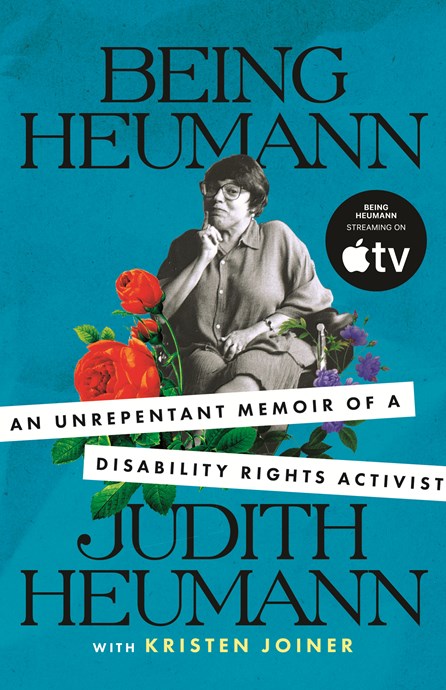
BEING HEUMANN
An Unrepentant Memoir of a Disability Rights Activist
**The feature film directed by CODA’s Sian Heder streams on Apple starting November 13th**
“This important book will help ensure that every person gets a chance to live up to their full potential and will always have a place at the table.”—Hillary Clinton
“Her life story as an activist will enlighten readers everywhere.”—Gloria Steinem
“Her fierce advocacy and work changing the laws around disability rights have undeniably paved the way for me to achieve what I have today. . . . A must-read.”—Ali Stroker, Tony Award-winning actress
One of the most influential disability rights activists in US history tells her personal story of fighting for the right to receive an education,
**The feature film directed by CODA’s Sian Heder streams on Apple starting November 13th**
“This important book will help ensure that every person gets a chance to live up to their full potential and will always have a place at the table.”—Hillary Clinton
“Her life story as an activist will enlighten readers everywhere.”—Gloria Steinem
“Her fierce advocacy and work changing the laws around disability rights have undeniably paved the way for me to achieve what I have today. . . . A must-read.”—Ali Stroker, Tony Award-winning actress
One of the most influential disability rights activists in US history tells her personal story of fighting for the right to receive an education, have a job, and just be human
A story of fighting to belong in a world that wasn’t built for all of us and of one woman’s activism—from the streets of Brooklyn and San Francisco to inside the halls of Washington—Being Heumann recounts Judy Heumann’s lifelong battle to achieve respect, acceptance, and inclusion in society.
Paralyzed from polio at eighteen months, Judy’s struggle for equality began early in life. From fighting to attend grade school after being described as a “fire hazard” to later winning a lawsuit against the New York City school system for denying her a teacher’s license because of her paralysis, Judy’s actions set a precedent that fundamentally improved rights for disabled people.
As a young woman, Judy rolled her wheelchair through the doors of the US Department of Health, Education, and Welfare in San Francisco as a leader of the Section 504 Sit-In, the longest takeover of a governmental building in US history. Working with a community of over 150 disabled activists and allies, Judy successfully pressured the Carter administration to implement protections for disabled peoples’ rights, sparking a national movement and leading to the creation of the Americans with Disabilities Act.
Candid, intimate, and irreverent, Judy Heumann’s memoir about resistance to exclusion invites readers to imagine and make real a world in which we all belong.
- Beacon Press
- Paperback
- February 2021
- 232 Pages
- 9780807002803
Buy the Book
$16.99

About Judith Heumann & Kristen Joiner
Judith Heumann (1947–2023) was an internationally recognized leader in the Disability Rights Independent Living Movement. She served in the Clinton and Obama administrations, and she was the World Bank’s first adviser on disability and development. Her memoir, Being Heumann, was adapted into a film of the same name by Siân Heder (CODA), and her story was featured in the Netflix documentary Crip Camp: A Disability Revolution (2020).
Kristen Joiner is a writer, activist, and producer. She is the co-author of Being Heumann and the YA version of the book, Rolling Warrior with Judy Heumann. Kristen co-founded the youth filmmaking organization, Scenarios USA, and executive produced short films written by young people and directed by award-winning directors. She lives in New Zealand with her family.
Praise
“Thoughtful and illuminating, this inspiring story is a must-read for activists and civil rights supporters.”—Publishers Weekly, starred review
“A driving force in the passage of the Americans With Disabilities Act looks back on a long career of activism… A welcome account of politics in action, and for the best of causes.”—Kirkus Reviews
“Consider this book an inspiring call for inclusiveness, courage, equity, and justice as well as a reminder of people’s power to change the world for the better.”—Booklist
“Heumann’s personality shines throughout. Her voice is witty, persistent, and at times irreverent as she immerses readers in her story.”—Library Journal
“With an energetic pace and a youthful voice, Ali Stroker narrates disability rights activist Judith Heumann’s memoir… Along with her friend and mentor, the late Ed Roberts, Heumann is a freedom fighter Americans need to know. This audiobook makes getting acquainted a delight.”—AudioFile Magazine
“Reading this memoir is like sitting down with a good friend and talking for hours, as self-described extrovert Heumann tells powerful and engaging stories from the frontlines of the disability civil rights movement.”—Health Affairs
“A moving chronicle of social change, Being Heumann will restore your hope in our democracy and the power of our shared humanity.”—Darren Walker, president, Ford Foundation
“Judy’s advocacy for disability rights began as a fight for her own future and then, as a leader of the movement, spanned the nation and the globe. As secretary of state, I relied on Judy’s insights, knowledge, sass, and wit to elevate advocacy for disability rights in our diplomacy. This important book will help ensure that every person gets a chance to live up to their full potential and will always have a place at the table.”—Hillary Clinton
“It’s one of the ironies of American life that the one category into which almost all of us will fit at some time in our lives—people with disabilities—is often the last on the list of included groups in this country… I met Judy Heumann almost four decades ago, and her writing, activist skills, and kindness helped me to see this simple truth. Her life story as an activist will enlighten readers everywhere.”—Gloria Steinem
“Judy’s vision of a society that embraces all aspects of the human condition and where we face adversity with wisdom is truly transformative… All who read her book will be better for it.”—Sheryl Sandberg, COO of Facebook, author of Lean In
“Judy’s story has shaken me to the core. For the first time, I see myself in someone else. Her fierce advocacy and work changing the laws around disability rights have undeniably paved the way for me to achieve what I have today… A must-read.”—Ali Stroker, Tony Award-winning actress
“A marvelous memoir by a disability hero who has paved the way for many of us. Full of fascinating stories from the disability rights movement, this book will guide future leaders as we work toward a barrier-free world.”—Haben Girma, author of the bestseller Haben: The Deafblind Woman Who Conquered Harvard Law
“Being Heumann changed me. This clear-eyed, gripping book is necessary reading for anyone in a body. Judy Heumann is a true heroine: practical, courageous, and totally badass.”—Sharon Guskin, author of The Forgetting Time
“Full of stories of triumph, love, and total badassery, Being Heumann is a look into a world and moment in history that very few know or appreciate. You don’t have to have a disability to completely relate to Judy’s story. Haven’t all of us been dismissed by others at some point in our lives? Readers will finish this book with a whole new perspective on people with disabilities and on their own lives too. Judy doesn’t just believe in the power of community and the potential of democracy to deliver equality and justice—she and her many friends and allies set out to prove, against all odds, that it is true. Their epic struggle to achieve civil rights protections for people with disabilities has remade our world, whether we realize it or not. Intimate and engrossing, this book is a profound gift. It should be read and cherished by all, as both an unforgettable portrait of one of our greatest activists and a road map for how to build a more just and inclusive world.”—Nicole Newnham and Jim LeBrecht, directors of Crip Camp
“For everyone who cares about human rights around the world, Judith Heumann’s moving story and message of belonging is also a powerful call to action. A must read.”—Yetnebersh Nigussie, disability rights activist
“If you’re searching for an excellent primer on the disability justice movement or a firsthand account of the power of the collective voice, you’ll want to pick up this book!”—Jey Ehrenhalt, Teaching Tolerance School-Based Programming and Grants Manager
Discussion Questions
- Early in her life, Judy is denied entry to school because she is considered a “fire hazard.” After she finishes college and has passed her exams to become a teacher, she is denied her teaching certificate on medical grounds. Later, when she fights for the Section 504 regulations to be signed for all disabled people, she is told that ensuring access is too expensive. Judy’s exclusion is explained away alternately as a safety issue, a medical problem, and a cost issue. Judy writes: “The truth is, the status quo loves to say no. It is the easiest thing in the world to say no, especially in the world of business and finance. But for the first time we were discussing civil rights, and no other civil rights issue has ever been questioned because of the cost.” What does Judy mean by this? How do these explanations appear reasonable and practical on the surface? What are they hiding?
- The idea that disabled people don’t need pity, charity, or admiration but require equal rights instead is a central theme of the book. What are the unspoken stories you have absorbed about disability and disabled people?
- The 1977 sit-in ultimately succeeded partly due to the support of a variety of very different groups and political organizations. For example, the Black Panthers delivered food, unions and churches sent endorsements of support, and the sit-in itself relied on previously separate disability groups coming together in a coalition. What type of leadership on the part of Judy and the other leaders made this type of coalition building possible? When have you experienced a moment of strength in your life that relied on the support of other people or collective action—versus going it alone?
- Judy was raised to believe that “no” was not always the final answer, which her mother modeled for her with a fierce determination. She writes, “The day-to-day work of fighting fell on my mother, which I take as a sign. Because if the universe really hadn’t wanted me to go to school, it wouldn’t have made Ilse Heumann my mother. Telling Ilse Heumann that something wasn’t possible was a big mistake.” When in your own life has refusing to accept a “no” changed what became possible? Is there a “no” you’re still living with that might be worth questioning?
- Throughout her life, Judy had to fight to simply be seen—to be counted as part of “everyone.” For example, when her mother took her to a public school for her first day of kindergarten and was told that Judy could not attend due to her use of a wheelchair, the implicit meaning was: This school is for everyone except those who use wheelchairs. Whose experiences are still left out despite institutions, schools, workplaces, or communities saying they serve “everyone”? What would it take to widen the circle?
- Being Heumann, the movie, focuses on the events of the sit-in and tells the story of several of the protesters, alongside Judy’s story. Why do you think the filmmaker made this choice? What can a film do that a book cannot? And what can a book do that a film cannot?
- Judy writes, “Our anger was a fury sparked by profound injustices. Wrongs that deserved ire. And with that rage we ripped a hole in the status quo.” The emotion of anger runs through this book—not as bitterness but as fuel. Yet, at the same time, Judy never writes anyone off or dismisses anyone as unreachable. When has anger helped you see your values clearly, helped you set a boundary, or confront an injustice? How do you keep asking for what you want without writing anyone off, even when you’re angry?
- Judy writes about her parents and how they influenced her later actions. She describes how the dinner conversations with her father, growing up, taught her to argue. And how her mother’s participation in community life affected her awareness of others. She says, “My parents weren’t obstinate or antiauthoritarian; they were thinkers. They had learned what happens when hatred and inhumanity are accepted. Both my father and my mother were brave people who lived by their values. They had personally experienced what happens when an entire country chooses not to see something simply because it is not what they wish to see. As a result, they never accepted anything at face value. When something doesn’t feel right, they taught us, you must question it—whether it is an instruction from an authority or what a teacher says in class.” How do these influences affect Judy’s choices and accomplishments? Who has influenced you and in what way? Who do you influence?
- So much of Judy’s fight was about being able to access what much of society takes for granted, from classrooms and the workplace to transportation. Her inability to access these areas affected her ability to participate fully in society, for example, when she and her friends couldn’t go to theaters or restaurants because of the lack of space for wheelchairs, or when disabled activists couldn’t physically get to the protests because they couldn’t get on a bus. Where have you noticed that access, or lack of access, influences who gets to be a part of everyday community places and events? What barriers prevent some people from being present and visible in the course of our everyday lives?
- Some of the people who fought with Judy did not live to see the end result of their incredible contribution. They left behind a legacy, and the fight for the inclusion of people with disabilities is very present still today. What are the issues that the disability rights movement faces today? How could you support their fight?
These questions were written by Kristen Joiner. She is a writer, speaker, and producer. Her work in social change led her to Judy Heumann and the five years they spent co-writing Being Heumann. Her writing has appeared in Stanford Social Innovation Review, Ms. Magazine, and elsewhere. She speaks at universities, nonprofits, and conferences on social change, storytelling, and her work with Judy.
Excerpt
How We’re Silenced and the Power of Judy Heumann by Kristen Joiner
Judy Heumann isn’t nice.
Let me be clear.
Judy Heumann, one of the most transformative disability rights leaders of our time, is very friendly. Just take a walk around her Washington, DC, block. You’ll see that she’s on a first-name basis with everyone, from the doorman to the bus driver. But she is not nice.
For the past three years, I’ve had the privilege of waking up and imagining myself into Judy Heumann’s shoes. I co-authored her story, Being Heumann: An Unrepentant Memoir of a Disability Rights Activist, and as a nondisabled person, I’ve learned (and am still learning) an enormous amount about life with a disability. Equally important, despite having spent my entire career leading NGOs and working for social change, I’ve also learned an enormous amount from Judy about activism.
Judy Heumann became a quadriplegic from polio at the age of one and grew up in 1950s Brooklyn—an era known for locking disabled people in institutions, segregating them into inferior special education programs, and shunting them into sheltered workshops as a proxy for “employment.” People with disabilities, stigmatized and ignored, were considered a burden. In the face of this discrimination, Judy became an activist for disability rights. In 1977, she and others led 150 disabled people into the San Francisco Federal building and refused to leave until the Carter administration enacted the first civil rights legislation for disability. This protest, the Section 504 Sit-In, is recognized now as the longest takeover of a federal building in US history. It paved the way for the American Disabilities Act.
In other words, Judy is a badass.
Judy speaks the truth. Unapologetically. Now, in case you don’t know good-girl lexicon, speaking the truth unapologetically is not considered nice. Nice is what girls are asked to perform to be considered desirable. Nice girls are soft, compassionate and, above all, agreeable. Nice girls don’t complain, have needs, ask for what they want, say no, get angry, refuse to do something, or make a fuss. Nice girls apologize when they get the wrong drink order.
Nice, however, is not just about gender. It is about power. When interacting with people with less power, sociologists have noted, people with power expect the less powerful to display considerate, cooperative, and nice behavior. When they don’t, people with more power aren’t just surprised—they’re annoyed and, even more, threatened. Not acting nice toward people with power is an inherent challenge to their privileged status.