
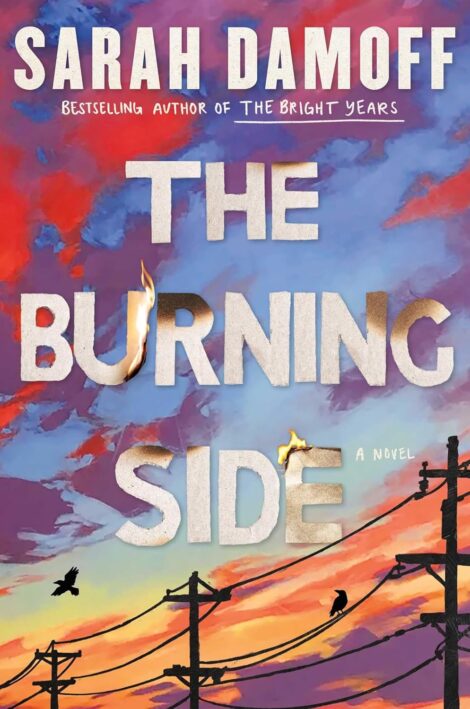
THE BURNING SIDE
From the author of The Bright Years, the story of April and Leo, a couple on the brink of collapse. When their house goes up in flames, family secrets and thorny histories emerge as they are forced to decide what is worth salvaging.
When April and Leo’s house burns in the middle of the night, they escape with their two young children and the quiet knowledge that the fire is not the only thing threatening their family. They retreat to April’s childhood home in Dallas, where her spirited parents and siblings provide both comfort and complication.
From the author of The Bright Years, the story of April and Leo, a couple on the brink of collapse. When their house goes up in flames, family secrets and thorny histories emerge as they are forced to decide what is worth salvaging.
When April and Leo’s house burns in the middle of the night, they escape with their two young children and the quiet knowledge that the fire is not the only thing threatening their family. They retreat to April’s childhood home in Dallas, where her spirited parents and siblings provide both comfort and complication.
As the family reckons with the aftermath—grief, guilt, logistics, and memories scorched and intact—the fire exposes the cracks already forming in April and Leo’s marriage. The novel unfolds in alternating perspectives: from April, who feels the crushing weight of motherhood, marriage, and self-blame; from Leo, a high school history teacher shaped by a lonely, fractured childhood; from Deb, April’s generous and no-nonsense mother who has to contend with her husband’s recent Alzheimer’s diagnosis; and from flashbacks that trace April and Leo’s relationship from its earliest days of connection to the devastating decisions that led them here.
A family saga suffused with humor, longing, and heartbreak, The Burning Side is about what we inherit and what we choose, about forgiveness and the ache of being known. It is, above all, about the meaning of home and the costs of long love.
- Simon & Schuster
- Hardcover
- May 2026
- 336 Pages
- 9781668085011
Buy the Book
$29.00

About Sarah Damoff
Sarah Damoff is the author of The Burning Side and The Bright Years, which was a USA TODAY bestseller. She lives with her husband and children in Texas, where she has been a social worker.
Praise
“Detailed in three different perspectives, the familial and romantic intricacies are ripe for discussion (and tons of tears)…a tender family saga.”—Martha Stewart, The Best Book Club Books of 2026
“[A] layered family saga… Damoff skillfully paints a picture of April and Leo’s rich, complex marriage…in The Burning Side, family—however unwieldy and difficult—is too precious a thing to throw away lightly.”—Bookreporter
“One of my all-time favorites…The Burning Side is just perfection. I feel more connected to all of humanity after connecting so deeply to this family—and feel honored to have spent time with these fictional souls.“—Zibby Owens, Totally Booked with Zibby
“Following the breakout success of her debut, The Bright Years, Damoff continues to explore the interplay of the many relationships that make up a family with rare sensitivity.“—Oprah Daily
“[A] heartbreaking tale of a family contending with its fractures in the wake of a devastating house fire…This will stay with readers.“—Publishers Weekly
Discussion Questions
- What do you think might have been different if the fire hadn’t happened?
- Leo thinks, “Ideals can be the sparks of love, and for us they were.” How does their idealism help Leo and April? How does it hurt them?
- Deb is a generous caretaker, but she has trouble letting others help her. Why do you think this is common for caretakers? How does Deb grow throughout the novel?
- Leo thinks, “I don’t know what to do with that—with a woman who both bandages and burns.” He wants April to be wrong or right, good or bad, but she is both. What outcomes do you notice when someone ignores the strengths or weaknesses of a loved one?
- April thinks, “It’s hard to have a shift of heart beside someone who is so familiar with it.” How does it speak to the difficulty of change in a long relationship?
- Why do you think Leo starts searching for his parents when he does?
- What were the different reactions of the three siblings when it came to genetic testing for early-onset Alzheimer’s? Did you understand one of them more than the others?
- When we see Leo as a child, the narrator says, “He carries the burden of the born: the want of his parents, whoever they are.” How does Leo’s understanding of his parents shift throughout the book? In what ways does this cause him to wrestle with his own identity?
- How did you feel about Billy giving Deb the pills? How did you feel when she dumped them?
- What blame does Leo carry that isn’t his? What blame that is his does he struggle to admit? Are these connected?
- In April’s journey with postpartum depression, she thinks, “Unhappiness is a privilege I have not earned.” Why does she think that, and how does this line of thought work against her?
- April thinks, “The question of forgiveness forces us to look at the wound.” How does forgiveness differ from ignoring a problem?
- What factors contribute to Leo changing his mind about the divorce? What about April?
- Which character did you relate to most? Least?
- How does memory vs. forgetfulness impact not only Deb and Billy, but also April and Leo?
- Leo thinks, “But there aren’t answers, I realize. There are stories.” Have you ever sat down with a parent, grandparent, aunt/uncle, mentor and asked about their story? Or with children, nieces, nephews to share your story? If so, how did it impact you? How did it impact them?