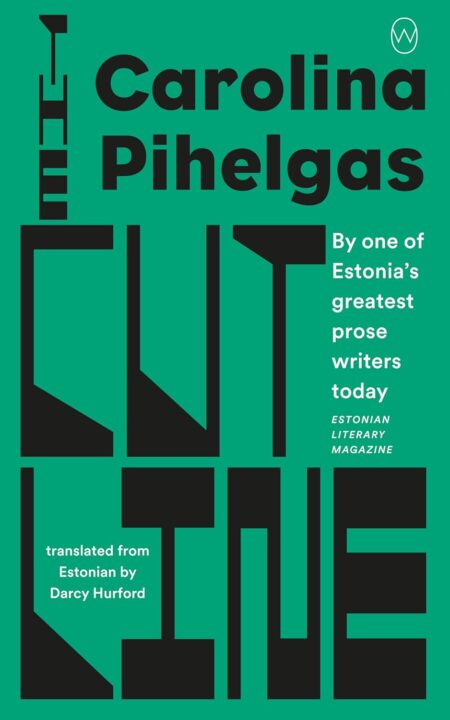
THE CUT LINE
In the dog days of an Estonian summer, Liine flees to the countryside to put a conclusive end to her toxic 14-year relationship.
She undergoes every stage of separation in a lone farmstead amid forests. Physical labor and gardening help her withstand her ex-partner’s threats, the incredulity of friends and family, and her own anguish. Dread is pervasive in this novel. Set in the near future, it is filled with vivid depictions of the threat of climate change. All around Liine, nature is facing acute drought and heat. No less menacing is the presence of an expanding NATO base close to the cottage at the Russian border.
In the dog days of an Estonian summer, Liine flees to the countryside to put a conclusive end to her toxic 14-year relationship.
She undergoes every stage of separation in a lone farmstead amid forests. Physical labor and gardening help her withstand her ex-partner’s threats, the incredulity of friends and family, and her own anguish. Dread is pervasive in this novel. Set in the near future, it is filled with vivid depictions of the threat of climate change. All around Liine, nature is facing acute drought and heat. No less menacing is the presence of an expanding NATO base close to the cottage at the Russian border. The world’s largest military alliance is practicing for an attack. Explosions and shots ring in the distance while Liine tries to recover from fourteen years of violence. Yet she simply follows the rhythm of nature as summer unfolds. While her environment changes around her, Liine-always in the garden chopping wood, weeding, sowing–undergoes profound transformations, too. The Cut Line is a story of fear, self-blame, grief, numbness, and anger ultimately giving way to hope and healing, joy and lightness.
- World Editions
- Paperback
- February 2026
- 142 Pages
- 9781642861617
Buy the Book
$19.99

About Carolina Pihelgas & Darcy Hurford (Translator)
Carolina Pihelgas is an Estonian writer, poet, translator, and editor. Her collection of prose poems Valgus kivi sees (‘The Light Within the Stone’, 2019) received the Estonian Cultural Endowment Award for the best poetry book of the year. In 2020, she was appointed Tartu’s City Writer Laureate. The author of seven collections of poetry published her first novel Vaadates ööd (Watching the Night) in 2022. The short novel The Cut Line is her second work of prose and her first work to be translated into English.
Darcy Hurford translates from Swedish, Finnish, and Estonian into English. Originally from England, she is now based in Belgium, where she has been working for around 12 years. She studied modern languages at the University of East Anglia and comparative literature at Åbo Akademi University in Finland. Her translations have appeared in Asymptote and Ellipse Magazine.
Praise
“Carolina Pihelgas’ second novel, The Cut Line, revolves around the inner life of a young woman who has recently ended an abusive, toxic relationship. The Cut Line is a book about boundaries-personal and natural, spatial and temporal. It is fascinating to see how these boundaries shift and merge.” —Estonian Literary Magazine
“Carolina Pihelgas delves deep, peers to the very bottom, is bold and confident, and never stops halfway.” —Piret Põldver, literary critic
“In less than one hundred pages, Carolina Pihelgas creates a depth that would perhaps not be possible without her poetic language, upon which she builds her rendering of the human soul. With this extraordinary little book, the poet undoubtedly reinforces her position as one of Estonia’s greatest prose writers today.” —Estonian Literary Magazine
Discussion Questions
1. In The Cut Line, Liine’s character development does not progress in a linear way; she struggles with setbacks and frustrations until the very end of the book. Why does author Carolina Pihelgas choose to represent Liine’s evolution in this way? What does this say about the lived experience of depression and trauma?
2. What is Liine’s relationship to Elvi and Selma? How would you describe the importance of their history to Liine’s self-discovery and search for healthy relationships? How does Elvi and Selma’s relationship provide a contrast to Liine’s relationship with Tarmo and her mother? What do these women teach her?
3. In what ways does Liine’s story in The Cut Line emphasize female sufficiency and matrilineage? How do these elements affect Liine’s character development? How do they manifest in her actions and emotional parcours?
4. One could argue that the Tsõriksoo farmhouse functions as a character itself, advancing the plot and acting on the characters. What makes it essential to Liine’s evolution? Why does Pihelgas choose this farmhouse as the book’s setting?
5. What is the significance of ending The Cut Line with the farmhouse’s imminent abandonment? What does this envision for the future of Liine’s character?
6. Liine finds release in nature. What does working with the land provide her? How does nature hold up a mirror to Liine’s emotional journey? How does it reflect her self-sufficiency and provide a contrast to her behavior in previous relationships (with her mother and with her ex)?
7. How does the political climate act on Liine’s personal story? Is it a passive or active element of the plot? How does it reflect Liine’s internal conflict?
8. What does “The Cut Line” represent for Liine? How would you describe this concept?