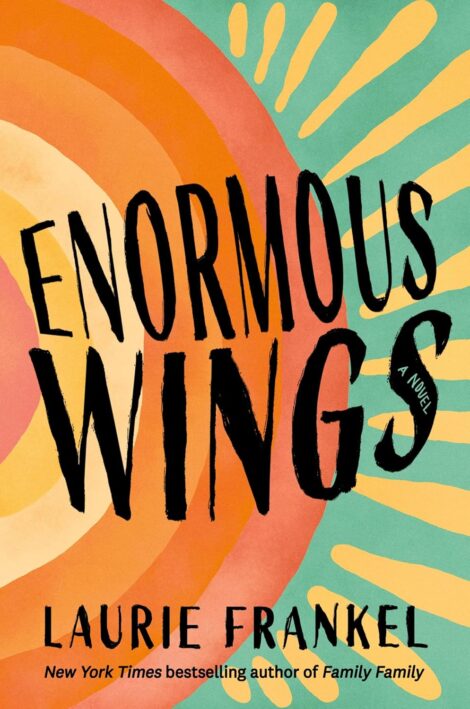
ENORMOUS WINGS
From the beloved New York Times bestselling author Laurie Frankel, an exuberant and timely new novel
At seventy-seven, Pepper Mills is too old to be a stranger in a strange land. She didn’t choose the Vista View Retirement Community of Austin, Texas—that would be her three grown children—but when she grudgingly moves in, she not only makes new friends, she falls in love. Then the exhaustion, vomiting, and confusion start. She fears it’s cancer, dementia, a stroke. But a raft of tests later, the news is even more shocking: She’s pregnant.
As word gets out,
From the beloved New York Times bestselling author Laurie Frankel, an exuberant and timely new novel
At seventy-seven, Pepper Mills is too old to be a stranger in a strange land. She didn’t choose the Vista View Retirement Community of Austin, Texas—that would be her three grown children—but when she grudgingly moves in, she not only makes new friends, she falls in love. Then the exhaustion, vomiting, and confusion start. She fears it’s cancer, dementia, a stroke. But a raft of tests later, the news is even more shocking: She’s pregnant.
As word gets out, everyone wants a piece of her: the press and paparazzi, activists and medical researchers, belly-rubbers and rubber-neckers all descending on Vista View while Pepper struggles to determine her next move. Soon she has some hard decisions to make—and some she’s not allowed to make.
Enormous Wings is an urgent novel about female agency and bodily autonomy, morality and mortality. It’s about what happens when you don’t get to choose anymore. It’s about motherhood and family, sex and love and friendship, and how those bedrocks—even so late in the day—can still change, and then change everything.
- Henry Holt and Co.
- Hardcover
- May 2026
- 304 Pages
- 9781250423771
Buy the Book
$28.99

About Laurie Frankel
Laurie Frankel is the New York Times bestselling, award-winning author of the novels Family Family, One Two Three, Goodbye for Now, The Atlas of Love, and the Reese’s Book Club Pick This Is How It Always Is. Frankel lives in Seattle with her husband, daughter, and border collie.
Praise
A May 2026 Indie Next pick
“Hilarious and humane, this big-hearted book captures the urgent state of women’s rights post-Dobbs.” —Ms. Magazine
“Only the fearless, funny, and endlessly inventive Frankel could have written this one-of-a-kind yet amazingly down-to-earth book about a woman’s right to choose.” —Oprah Daily
“Brilliantly makes the impossible plausible, intricately collaging questionable medical treatments, geriatric sexuality, teenage pregnancy, women’s fertility and autonomy, religious and political oversteps, and so much more. . . . Frankel is poised (again) to make plenty of readers uncomfortable while also offering entertainment and illumination.” —Booklist (starred review)
“In the hands of a lesser writer, this story would flounder, but Frankel’s deft understanding of nuance makes each argument, interaction, and forced conversation between the characters into an epiphany for modern readers to ponder and appreciate. VERDICT: An unusual premise, supported by great writing, makes this novel work.” —Library Journal
“Frankel blends humor and gravitas in her portrait of an expectant mother who’s also facing her own mortality. Fans of the author’s quirky family stories about hot-button issues will find much to enjoy.” —Publishers Weekly
Discussion Questions
- Do you buy the premise of the book? A pregnant seventy-seven-year-old? Are you able to suspend your disbelief? Are you convinced by Dr. Kim’s explanations, or are you content to have an element of magic in a novel that is otherwise realist?
- How does this remarkable pregnancy serve as a metaphor for issues of female agency and health care in this novel? What about issues of senior agency and health care?
- What links are there between the choices elders get to make (and don’t get to make) and the choices pregnant people get to make (and don’t get to make)?
- Pepper tells the reader about teaching a short story by Gabriel García Márquez called “A Very Old Man with Enormous Wings.” How do the themes and moral of that story apply to this novel? How else do enormous wings feature here?
- Pepper’s three adult children are very different from one another. Whose approach to caring for Pepper seems best or kindest or most effective and whose least? Which of these parent/adult-child relationships was most relatable to you?
- Maisie tells Pepper that Moth is very popular, and indeed, everyone wants to dance with him at Senior Prom. He could date just about anyone, which we suspect has been true for many years, but he chooses only Pepper, and chooses her at once and unwaveringly. Why her, and what does it tell you about him?
- Pepper also falls in love with Moth at more or less first sight. She falls for Maisie and Dot just as quickly. Are relationships easier or closer as we age?
- Why do you think the author opens the book with a profane Episcopal priest? What is Father Frank’s role in this story?
- Dot’s reaction to her cancer diagnosis is “One of these days, you get something you won’t live through. Happens to the best of us. And, come to think of it, the worst.” How does Dot go about the process of dying? What role does her dying play in a book about new life?
- Do you like Roger? Does Pepper? Discuss their version of divorce and their relationship all these years later.
- Are you convinced by Moth’s arguments that there are lots of ways it’s easier for older adults to parent an infant? What have Darcy and Alice sacrificed to parenthood that Pepper and Moth wouldn’t have to?
- Pro-choice and anti-choice activists are both interested in Pepper as a spokesperson. Why does each side think Pepper embodies their cause? How do abortion arguments on both sides differ from the ones we all know when the abortion-seeker is an old woman?
- How have Maisie, Dot, and Pepper’s pre-Roe v. Wade memories shaped their positions on reproductive care? Are there other policy areas where we are or should be taking guidance from the wisdom of the elders?