
ETNA
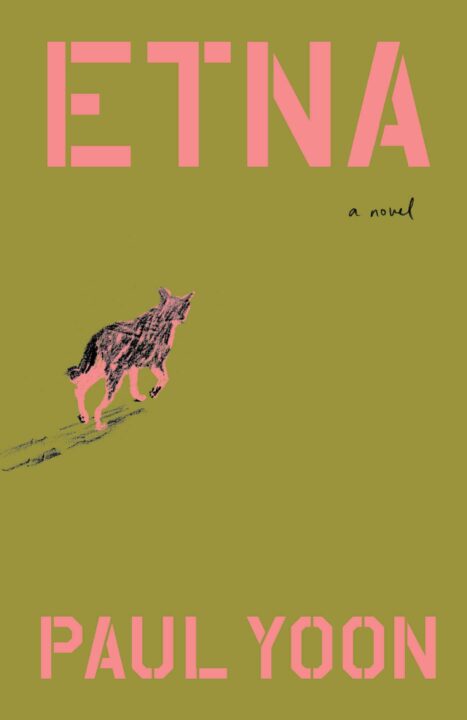
Set in a fictional country in the present day, this is a story told through the eyes of an ex-military dog, Etna. After surviving years of a devastating war, Etna decides one night to leave the men he has fought alongside for years and return home—to the place where he was taken from when he was young, in the thin but persistent hope that if a home exists for him, it might be there.
Thus begins an exhilarating odyssey told through the eyes of a dog as he traverses across ruined landscapes and fights to survive in a world that,
Set in a fictional country in the present day, this is a story told through the eyes of an ex-military dog, Etna. After surviving years of a devastating war, Etna decides one night to leave the men he has fought alongside for years and return home—to the place where he was taken from when he was young, in the thin but persistent hope that if a home exists for him, it might be there.
Thus begins an exhilarating odyssey told through the eyes of a dog as he traverses across ruined landscapes and fights to survive in a world that, even in peacetime, proves to be just as precarious. Along the way, he encounters other animals and humans who are attempting to figure out how to start again. What makes a life when there is no home to go back to? How do we begin to trust each other again after such profound loss?
This is a novel about the power of an idea, about never giving up, and ultimately a novel about finding hope in the most dire of times.
- Scribner
- Hardcover
- August 2026
- 208 Pages
- 9781668020821
Buy the Book
$28.00

About Paul Yoon
Paul Yoon is the author of six works of fiction: Etna; Once the Shore, a New York Times Notable Book; Snow Hunters, winner of the Young Lions Fiction Award; The Mountain, an NPR Best Book of the Year; Run Me to Earth, a Time Must-Read Books of 2020 and longlisted for the Andrew Carnegie Medal for Excellence in Fiction; and The Hive and the Honey, winner of the 20th Annual Story Prize and longlisted for the Joyce Carol Oates prize.
Praise
“Devastating and gorgeous.” —The New York Times Book Review
“Keenly wrought… Etna stands out among Yoon’s work… For all its compactness, Etna has the shape of an epic…tied deeply into both ancient literary tradition and tragically perennial concerns…In Yoon’s hands, a character’s suffering never overwhelms their capacity for tenderness. The author always insists on the enduring humanity of his displaced subject—even when they aren’t human.”—Rachel Vorona Cote, The Atlantic
“In this slim, extraordinary fable about a dog in wartime… Yoon captures Etna’s experiences and heroism in clear, transcendent language. No dog lover should miss this.”—People Magazine
“Don’t let the book’s length mislead you, though: Etna’s odyssey also deserves the epithet ‘epic,’ and the characters who populate it have lived on in my mind long past the book’s final line.” —NPR, Best of August
“Yoon’s spare, precise, beautiful language lifts a conceit that could have been hokey or gimmicky into something revelatory: a glimpse of human folly and cruelty through eyes of the utmost innocence. …A gorgeous reminder of our ability to look searingly and soulfully at who we are and what we’ve become.”—Frank Bruni, The New York Times
“In barely 200 pages, Yoon hands the reader a piercing classic about survival and about the search for home and family, a longing for a pack of one’s own, that persists in the face of the ultimate brutality. Perhaps no one, human or dog, ever outruns war.”—Financial Times
“Magnificent… an epic journey of hope… Yoon crafts yet another literary miracle, gorgeous in spare prose and dense with wrenching empathy on pages that may become saturated with tears. Amid today’s exhausted desensitization, Yoon gives readers an antidote of pure emotion.”—Booklist, Starred Review
“Thrilling…A propulsive narrative of unrelenting sadness may sound oxymoronic, but that’s the conjurer’s trick Yoon pulls off. The ability to return home after tragic events sometimes requires a redefinition of home, as Etna and his compatriots discover in this elegant work.” —Shelf Awareness, starred review
“Yoon’s story of a military working dog attempting a treacherous journey home in the aftermath of an unnamed war rarely moves in expected ways…Yoon’s fabulist shading situates the story at a nexus of grim reality and hopeful fairy tale, enlivening and devastating readers in equal measure as they watch Etna reckon with the all-too-human conclusion that one can’t go home again. Yoon sidesteps the schmaltz of so many animal stories and delivers something far richer in emotion and conviction.” —Library Journal, Starred Review
“A combat-trained dog sets out for home after a war in this magnificent novel… Not only does Yoon pull off a fresh take on well-worn Homeric themes and convincingly capture a dog’s perspective, but he offers subtle and stirring insights on the nature of faith, which might not always provide salvation but can be enough to keep people (and dogs) going. The author has outdone himself.” —Publishers Weekly, Starred Review
“If Homeward Bound and Au hasard Balthazar had a baby, it would be Etna. Yoon’s latest work is told through the eyes of an ex-military dog who decides to return home after years of war. On his journey, Etna revisits the places he worked during the war and finds them changed. He meets people and animals struggling to readjust after brutal battles upended their lives, and learns the complexities of life during ‘peacetime.’ But Yoon’s novel offers more reasons for hope than despair as it asks challenging questions about loss, trust, and, of course, home.” —Literary Hub, “Lit Hub’s Most Anticipated Books of 2026”
“Gorgeous…a sublimely quiet depiction of loneliness and disorientation.” —Hernan Diaz, Pulitzer Prize winning author of Trust and In the Distance
Discussion Questions
1. Why do you think the two epigraphs were chosen? Revisiting them now after finishing the story, do they hold a different resonance?
2. Soojin is the only human who can understand Etna. What does this tell you about her character? Why do you think she possesses this special understanding?
3. Animals seem to have no such language barriers with one another—Etna speaks with a donkey, a cat, a bird, and with other dogs. Why do you think Yoon made this creative choice? How does communication create closeness between some characters and distance between others?
4. Which encounters of Etna’s did you find the most moving? Why?
5. This war unfolds in a fictional, present-day country. Why do you think Yoon chose to fictionalize the country instead of choosing one we know?
6. As Etna follows the train tracks to the city, he says, “I was aware, with a new intensity, of my aloneness” (68). How does loneliness and isolation shape Etna’s journey? How does this inform the importance of pack, of community, and of home?
7. What is your interpretation of the ending?