
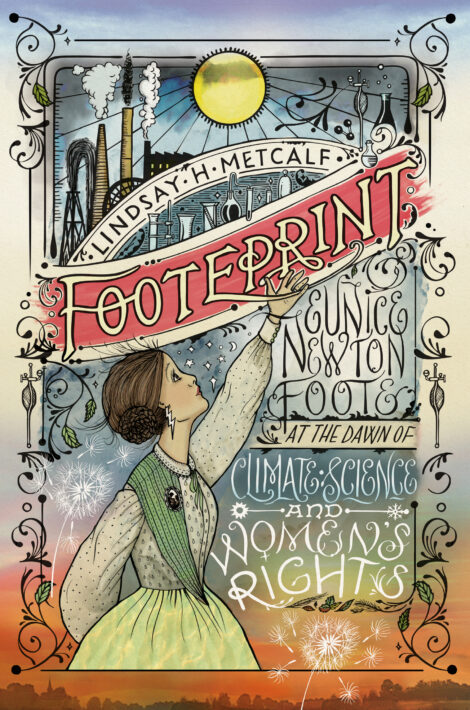
FOOTEPRINT
Eunice Newton Foote at the Dawn of Climate Science and Women's Rights
A fascinating historical novel-in-verse for young adults capturing the discoveries of Eunice Foote, a remarkable woman in science WAY ahead of her time.
A fictionalized account of the first woman to identify carbon dioxide as a cause of climate change in 1856 when most people preferred that women be seen rather than heard.
Fictionalized only to weave together some unknown pieces of Eunice’s life, this is a journey through time, triumph, trepidation, and trauma, revealing the extraordinary life and work of Eunice Newton Foote.
Eunice’s most important discovery was recognizing the effect of excess carbon dioxide in the atmosphere: a warming planet.
A fascinating historical novel-in-verse for young adults capturing the discoveries of Eunice Foote, a remarkable woman in science WAY ahead of her time.
A fictionalized account of the first woman to identify carbon dioxide as a cause of climate change in 1856 when most people preferred that women be seen rather than heard.
Fictionalized only to weave together some unknown pieces of Eunice’s life, this is a journey through time, triumph, trepidation, and trauma, revealing the extraordinary life and work of Eunice Newton Foote.
Eunice’s most important discovery was recognizing the effect of excess carbon dioxide in the atmosphere: a warming planet. But in a society driven by coal, kerosene, and crude oil, Eunice’s warnings went unheeded. After all, who would listen to a woman—especially a woman known to consort with suffragists?
From the Seneca Falls Convention to the halls of the US Patent Office in Washington, DC, Eunice Newton Foote blazed a trail for independence and inquiry. Today Eunice’s discoveries feel ever more prescient. She knew that reliance on fossil fuels would have a devastating effect. Today she is finally receiving the credit she deserves.
Eunice Newton Foote’s extraordinary tale is told in novel-in-verse format, perfect for teenagers interested in STEM.
- Charlesbridge Teen
- Hardcover
- February 2026
- 304 Pages
- 9781623546335
Buy the Book
18.99

About Lindsay H. Metcalf
Lindsay H. Metcalf grew up on a Kansas farm and is the coeditor of the poetry anthologies No Voice Too Small and No World Too Big, as well as author of Outdoor Farm, Indoor Farm; Beatrix Potter, Scientist; and Farmers Unite! Planting a Protest for Fair Prices. An experienced journalist, Lindsay has covered a variety of changemakers as a reporter, editor, and columnist for the Kansas City Star and other news outlets.
Praise
“A fictionalized account of the life of Eunice Newton Foote (1819–1888), a pioneering but long overlooked climate scientist, inventor, and women’s rights advocate.
Metcalf traces her subject’s early years in a family that nurtured her curiosity, eventually sending her to New York’s only science-focused girls’ seminary, where her roommate was Elizabeth Cady Stanton’s sister. She married Elisha Foote, a lawyer and inventor, who supported her experiments and her fight for gender equality. In 1856, the American Association for the Advancement of Science accepted Foote’s groundbreaking study on greenhouse gases—but demanded a man present it at their convention. Elisha was voted a member of the AAAS; Foote was not. In 1860, English scientist John Tyndall was credited with “discovering” greenhouse gases. Still, Foote carried on, patenting her inventions. A speculative section in which Foote and her daughter Mary travel to Europe and confront Tyndall feels inessential to the narrative. The final chapter describes how, in 2010, retired geologist Raymond Sorenson stumbled upon Foote’s original 1856 report and wrote an article that set the record straight. Although at times her reliance on figurative language feels excessive, Metcalf’s research shines through in the vivid details and contextual information about racial and gender bias surrounding Foote, who was white. This novel in verse effectively illuminates the life of a woman who pursued science despite systemic barriers. A valuable corrective to erasure in climate science history.” —Kirkus Reviews
“Using unadorned verse, Metcalf (Tomatoes on Trial) chronicles the experiences of scientist Eunice Newton Foote (1819–1888) combatting gender discrimination to pursue patents for her groundbreaking inventions in this comprehensive fictionalized biography of an overlooked pioneer. Born in Goshen, Conn., Foote—the youngest of 12 and cousin of Sir Isaac Newton—is raised in a science-minded family (“Justice & science/ fold into curious Eunice,/ mold into her bones”). At 15, she attends Troy Female Seminary, the country’s first school for women’s higher education. In 1841, she marries attorney Elisha Foote and, in 1842, invents a device that regulates the heat of stoves. Aware of the scientific community’s prejudice against women, Foote shares her ideas by whatever means she can, including applying for patents under her husband’s name. And when Irish scientist John Tyndall is credited with launching initial investigations into climate science in 1859, Metcalf challenges that accreditation in a poem titled “Combustion,” employing forthright lines to detail Foote’s own experiments on greenhouse gases and her subsequent findings, which were presented to the American Association of the Advancement of Science in 1856—three years before Tyndall. Diligently researched passages highlight the accomplishments of a female scientist only recently being recognized for her discoveries.” —Publishers Weekly
Discussion Questions
-
This book is categorized as fiction, although it is closely based on history. Read the author’s note in the back and discuss: Where does this book depart from nonfiction? Would you categorize it differently? When writing about history, where is the line between fiction and nonfiction? What kind of sources do historians draw on when writing history?
-
In the foreword, author and historian Leif HerrGesell writes, “We are all educators in this world, whether we share our knowledge in a classroom or through the pages of a book or in impassioned conversations.” Do you agree? How are you an educator in this world? What do you teach and how?
-
What kind of challenges did Eunice Newton Foote face in her pursuit of scientific inquiry? Are there people who face similar challenges today?
-
Discuss the images in the center of the book (pages 152–163): Why do you think the author selected these images? What additional context do these portraits, diagrams, and photographs give to Eunice’s story? Read “Could This Be Eunice?” (page 268) and discuss: Do you think this is Eunice? What “incontrovertible evidence” do you think a historian would accept to confirm that this portrait shows Eunice? What is the significance of finding an image of a person whose face has otherwise been lost to time?
-
This book is divided into three parts, each prefaced with an epigraph by Mary Foote Henderson, Eunice’s eldest daughter. Do you have a favorite of these epigraphs? Read “Mary’s Full Letter” (page 271) and consider whether and how your understanding of these epigraphs changes once you have read them in context.
-
Why do you think the author chose to write Footeprint as a novel in verse? How would this biography be different as a work of prose?
-
The refrain “be it known” appears throughout this book (pages 6, 28, 31, 109, 125, 209, 244, 261). What does this refrain mean? Why do you think the author chose these words to characterize so many moments in Eunice Newton Foote’s life? If you could select a refrain for a biography of your favorite historical figure, what would you choose?
-
The word “excelsior” also appears frequently in this book. What does “excelsior” mean? What do the appearances of this word have in common (pages 36, 50, 101, 239, 259)? What is your state’s motto? Is there a motto of a school or organization you belong to that you find personally meaningful?
-
Many of the poems in this story are concrete or have concrete elements; that is, the words are intentionally arranged and styled on the page to convey meaning beyond the words. Why do you think the author chose to use these visual elements? Do you have a favorite of the concrete poems in this book?
-
What is the origin of the phrase “glass ceiling,” invoked in the first poem of this book?