
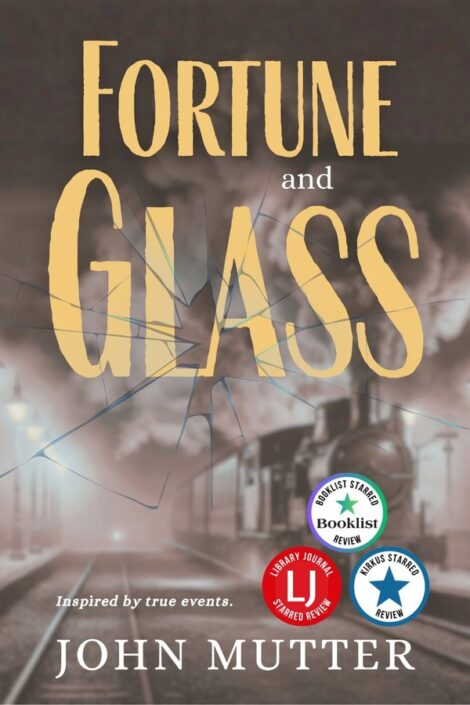
FORTUNE AND GLASS
Berlin, 1932.
Germany’s fragile democracy is fracturing, its ideals cracking like thin glass as political violence and paranoia seep into the streets.
In the midst of this tension, Rudi, a young Foreign Ministry official, meets Sara, an unpredictable, morally fierce Jewish woman whose connection with him is immediate and combustible.
By 1943, the Germany they knew has vanished, and Rudi works at the center of Nazi power, performing his duties by day and passing intelligence to the Allies by night— until Sara’s unexpected return threatens to unravel the life he has carefully constructed to survive.
Fortune and Glass is a philosophical spy novel and literary love story about private choices, secret resistance, and the cost of staying human inside a system determined to erase individuality.
Lyrical, atmospheric, and morally complex, it explores the gray zones of living under authoritarianism and asks a timeless question: Who are you when everything falls apart?
For readers who crave the psychological tension of le Carré, the philosophical resonance of Ishiguro, the emotional intensity of Schlink, and the moral suspense of Graham Greene, this is the WWII novel they haven’t read.
Fortune and Glass is not another WWII novel—it’s a love story braided through a psychological spy narrative, unfolding at the moment when ideals, identities, and institutions begin to fracture.
Rudi, a reluctant conspirator inside the German Foreign Ministry, and Sara, the brilliant, unpredictable woman he has never stopped loving, move through a Berlin where resistance and complicity live side by side in every breath.
Their choices become more dangerous and more intimate as the Nazi state tightens its grip, raising the urgent and timeless question: What is to be done when everything is breaking?
Lyrical, morally complex, eerily relevant, and emotionally riveting, Fortune and Glass offers something rare: a WWII-era story for readers who think they’ve read them all— because this one is about who we choose to be, not the war itself.
- Left Field Publishing
- Hardcover
- October 2026
- 390 Pages
- 9781966883074
Buy the Book
$30.00

About John Mutter

Praise
“DEBUT Mutter’s first novel is narrated through the eyes of Rudi, a German Foreign Ministry official, as he navigates shifts in friendship, political loyalties, and love on the eve of World War II. It’s 1932 when he first meets Sara, a Jewish woman for whom he falls head over heels. He is married with children when Sara reenters his life in 1943, yet the two cannot resist each other. Both the love story and the political storylines are slow burns, but in the best possible way—lyrical, atmospheric, and refreshingly complex. The alternating tension between Rudi’s relationship with Sara and his desire to make a difference during the war creates multiple morally gray areas for readers to explore. As the Nazis gain power, Rudi’s long-term friendships with men are tested, and Mutter’s well-written dialog enhances the delicate power dance and ambiguity within those relationships. The ending offers just enough resolution for readers to feel satisfied while still leaving room for speculation about each character’s future. VERDICT Mutter’s spy novel wrapped in a love story is compelling and beautifully written, offering a unique narrative amid the crowded field of World War II fiction. Book clubs will find this debut impossible to resist.” —Library Journal, starred review
“An unusually restrained but powerful novel about the darkest of times.”—Kirkus, starred review
“Debut author Mutter, journalist and cofounder of Shelf Awareness, studied in Germany, and that experience comes to the fore in this philosophical love story about the rise and fall of the Third Reich in Germany and the quiet resistance against it by two intertwined characters. Readers follow discussions at the dinner table as the votes are about to be cast in 1932, then stand with the crowd on January 30, 1933, as the unnamed narrator begins to understand what exactly has befallen his country. Through it all, he loves and protects Sara Traum, a free-spirited Jewish woman who refuses to abandon her home and her family even as it first abandons, then seeks to kill her. FORTUNE AND GLASS is an outstanding book not only for its skilled prose and relatable characters but for its unflinching portrayal of every single stage of the Nazis’ rise to power. Depicting everything from the insistence by some that the Nazis will never keep power to the unexpected fervor of the protagonist’s childhood friend when Hitler wins to the blatant cruelty of the Nazis themselves as they snatch people from their homes and families, this is a book that will stay with readers for a long time.” —Booklist, starred review
“Gripping, atmospheric, and thought-provoking. In the dark days of wartime Berlin, Rudi Baumann devises a quietly bold and risky way to resist the Nazi regime by using his position at the Foreign Ministry as cover. Lyrically written, FORTUNE AND GLASS blends espionage and forbidden love, courage and consequences, into a captivating narrative that simmers all the way to a poignant end.” —Shannon McKenna Schmidt, author of The First Lady of World War II: Eleanor Roosevelt’s Daring Journey to the Frontlines and Back
“From the Prologue’s first sentence, I knew John Mutter’s FORTUNE AND GLASS was going to be impossible to put down. And I was right. With each turning page my heart was in my throat as I was brought into a dark period in our history while being reminded that nothing is certain. The scenes are visual, the anxiety real thanks to Mutter’s impressive albeit disturbing undertaking. Mutter has been a force in the book world for quite some time, and now he deserves to have his books on those shelves, too. Did I say ‘books?’ Indeed I did. Mutter is too talented to stop at this debut.” —Carol Hoenig, author of Before She Was a Finley and The Liberation of Jane Carter
“John Mutter’s FORTUNE AND GLASS is thoughtful and provocative yet heart-in-your-throat fast paced. Even now, I find myself thinking about the protagonist, Rudi Baumann, an ordinary and conscientious government bureaucrat who discovers within himself the moral will and courage to confront the evils of fascism. Rather than the battle fields so prevalent in World War II fiction, Mutter gives us a rich portrayal of thirties and forties Germany and the difficult choices individual people had to make as Hitler rose to power. Historical fiction at its best!” —Suzanne Staubach, author of A Garden Miscellany: An Illustrated Guide to the Elements of the Garden
Discussion Questions
1. Which character did you feel most drawn to, and did that change at any point?
2. What meaning does the title FORTUNE AND GLASS take on by the end of the novel?
3. Do you think the characters are in control of their lives or reacting to forces around them? Why?
4. What does the story suggest about the trade-offs people make to get what they want?
5. Throughout the novel, characters are often navigating incomplete or distorted information. How does it shape the choices they make?
6. Did any particular scene or image stay with you after finishing? Why that one?
7. Several characters make decisions they believe are justified in the moment. In those situations, which choices do you think you would have made?
8. The novel touches on how quickly situations can escalate when systems break down or communication fails. Where do you see parallels to real-world situations today?
9. In what ways does FORTUNE AND GLASS mirror current events or dynamics in today’s world, whether in business, politics, power structures, trust, or information?
10. Do you think the kinds of decisions made in the book are more common or more visible in today’s world? Why or why not?
Interviews
- Bookreporter.com newsletter opener: “Embrace Fall“; September 25, 2026
- Authority magazine: “John Mutter Of Shelf Awareness On How To Write A Book That Sparks A Movement”; Aug 30, 2026
- Advance Reading Copy with Jon Mayes: “JOHN MUTTER”; Aug 30, 2026
- Shelf Awareness: Special issue with interview; Aug 17, 2026