
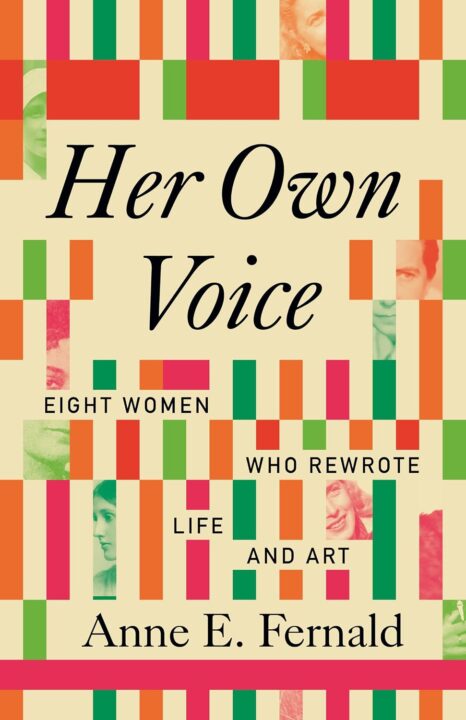
HER OWN VOICE
Eight Women Who Rewrote Life and Art
With Virginia Woolf as a guide, the stories of eight radical 20th century women–wanderers, rebels, explorers, mentors–who made a life for themselves in spite of everything.
Everything that changed in the 20th century changed more dramatically for women. Her Own Voice tells the stories of eight radical women who responded to social oppression and helped create the modernist movement.
As we witness the strong resurgence of trad wife popularity in modern culture, this book calls on women of every generation to actively wrestle with old ideas about what it means to be “good”
With Virginia Woolf as a guide, the stories of eight radical 20th century women–wanderers, rebels, explorers, mentors–who made a life for themselves in spite of everything.
Everything that changed in the 20th century changed more dramatically for women. Her Own Voice tells the stories of eight radical women who responded to social oppression and helped create the modernist movement.
As we witness the strong resurgence of trad wife popularity in modern culture, this book calls on women of every generation to actively wrestle with old ideas about what it means to be “good” and even “lovable.” Anne E. Fernald, world-renowned Virginia Woolf scholar, argues that the stories we read shape the lives we imagine for ourselves, and offers these stories as possible templates for living boldly and creatively.
Among the women featured are:
Margaret Wise Brown, groundbreaking author of Goodnight Moon
Jessie Redmon Fauset, prolific novelist of the Harlem Renaissance
Dorothy Arzner, the only woman director to make the transition from silent to sound films
The women in this book encompass a wide range of diverse identities: Black, white, Asian, lesbian, queer, straight, mothers, aunts, teachers; novelists; poets, filmmakers, musicians, producers. Altogether, they provide an inspirational reminder that the social and political upheaval of our time is nothing new; women have been working to overcome enormous barriers in the name of their art throughout history.
- Beacon Press
- Hardcover
- August 2026
- 304 Pages
- 9780807021330
Buy the Book
$29.95

About Anne E. Fernald
Anne E. Fernald is Professor of English at Fordham University in New York City and one of the world’s best-known experts on Virginia Woolf.
Praise
“Drawing from their writings, Fernald creates sensitive portraits of her subjects . . . An intimate look at women and their time.” —Kirkus Reviews
“A generous book with some surprising choices as subjects. Fernald ably draws on scholarship while keeping the text accessible.” —Library Journal
“Following in Woolf’s footsteps, [Fernald] revitalizes the biography, a form which has primarily served men, to revise the legacies of these bold wanderers and explorers, these overlooked rebels and mentors. Fernald’s group biography illuminates less-traveled paths to live by.” —Booklist
Discussion Questions
1. Which of the eight women offered a particularly compelling—or surprising—example of what it means to live boldly? Why did her story resonate with you?
2. The eight women profiled in the book came from different racial, cultural, economic, and personal backgrounds. How did those differences shape the opportunities available to them and the obstacles they faced? What similarities did you notice across their experiences?
3. Many of these women challenged conventional ideas about how a woman was expected to behave, work, love, or live. Which expectations proved the most difficult for them to resist? Do you think those expectations have truly disappeared?
4. How did the restrictions these women faced influence their creative work? In what ways did pushing against boundaries in their personal lives allow—or compel—them to push boundaries in their art as well?
5. Virginia Woolf serves as a touchstone throughout the book. How did her ideas about women, independence, creativity, and the need for “a room of one’s own” help connect the lives of these eight very different women?
6. How did each woman challenge the conventions of her particular field? Did you see connections between the risks she took creatively and those she took in her personal life?
7. Fernald considers these women’s rejection of traditional gender roles alongside the contemporary resurgence of the “tradwife” ideal. Why do you think traditional ideas about womanhood continue to reemerge? What might the lives in this book contribute to that conversation?
8. Many of the battles these women fought remain relevant today. Which aspects of their experiences felt most contemporary to you?
9. One of the book’s central ideas is that seeing how other women have lived can expand our sense of what is possible in our own lives. Did reading Her Own Voice change the way you think about your own ambitions or creative life? Is there one woman whose story you expect to carry with you?