
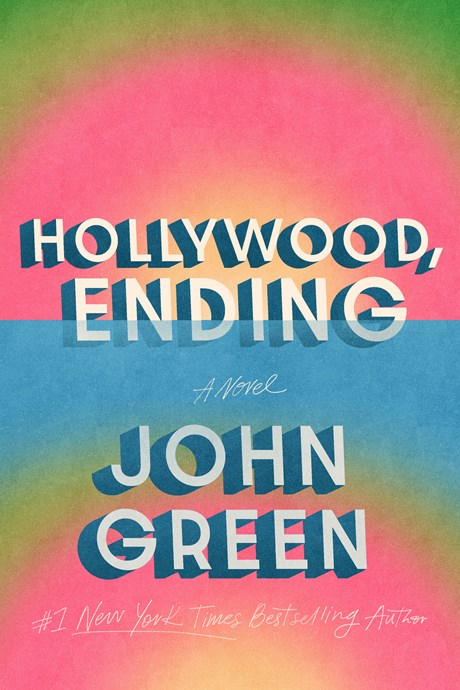
HOLLYWOOD, ENDING
#1 bestselling author John Green makes his much-anticipated return to fiction with a behind-the-scenes Hollywood love story about finding someone to trust in an untrustworthy world.
For rising talents Kai Laramie and Juniper Castillo, being cast in the buzzy biopic Andy Warhol Never Gets Old is the opportunity they’ve both been waiting for. They’re on the verge of breaking out, and maybe even falling in love. Soon, the movie is blowing up, and so are their lives—in exciting, but also terrifying, ways.
John Green artfully blends a behind-the-scenes Hollywood love story with an unflinching examination of the insatiable attention economy.
For rising talents Kai Laramie and Juniper Castillo, being cast in the buzzy biopic Andy Warhol Never Gets Old is the opportunity they’ve both been waiting for. They’re on the verge of breaking out, and maybe even falling in love. Soon, the movie is blowing up, and so are their lives—in exciting, but also terrifying, ways.
John Green artfully blends a behind-the-scenes Hollywood love story with an unflinching examination of the insatiable attention economy. Told through dual points of view, the novel brilliantly juxtaposes the on-screen study of Warhol’s life at the dawn of celebrity culture with the intimate struggles of two young people figuring out who they are, both together and alone.
Tender, heartbreaking, and shrewdly funny, this is a story as only Green can tell it. Hollywood, Ending is a deeply observed novel about the tension between a public and a private life, and the audacity to pursue the kind of love we all deserve.
- Dutton Books
- Hardcover
- 304 Pages
- https://bookshop.org/a/6133/9780525426073
Buy the Book
$32.00

About John Green
 John Green is the award-winning, #1 bestselling author of books including Looking for Alaska, The Fault in Our Stars, Turtles All the Way Down, The Anthropocene Reviewed, and Everything Is Tuberculosis. With his brother, Hank, John has co-created many online video projects, including Vlogbrothers and the educational channel Crash Course. John’s books have won many prizes, including an Audie Award, an Edgar Award, the Michael L. Printz Medal, and a Los Angeles Times Book Prize. John lives with his family in Indianapolis. You can visit him online at johngreenbooks.com.
Praise
“Green’s a tender writer whose abiding concern through all his work is what it takes to remain decent in a ruthless and impersonal world… Today, it is more crucial than ever.” ―Slate
“A characteristically quick-witted, emotive story about falling in love, the machinations of the film industry, the pitfalls of celebrity status, and the indelible value of making art.” —The Boston Globe
“A tale loaded with showbiz lore and American obsession with celebrity.” —TIME
“A love story but also an interrogation of modern stardom, art and the struggle to be real in a social media-fueled world of artifice and performance… Breathtaking.” ―US Weekly
“A classic portrait of young love.” —Kirkus, starred review
“In the author’s anguished portrait of modern fame, the most challenging performance is that of an authentic self… Kai emerges vividly on the page. Green depicts the young man’s bewilderment with radiant empathy.” ―The New York Times
“A triumphant return.” —PureWow
“Thought-provoking and captivating.” —Daily Beast
“In an era in which more and more people must market themselves on social media, Green still hopes we’ll find something better.” —Guardian
“A fascinating glimpse behind the scenes at the Hollywood machine and its vast apparatus, as well as the betrayals both small and large that keep it running.” —Bookreporter
“It’s been nine years since Green last published fiction, but this story about what fame does to the people inside it is well worth the wait.” —Good Housekeeping
“Reflections on Warhol’s profound grasp and exploitation of the vicissitudes of celebrity and the commodification of art and life shape the novel’s provocative and suspenseful conflicts… A spellbinding, tender, incisive, funny, and compassionate story of love and creativity.” —Booklist, starred review
Discussion Questions
- Hollywood, Ending follows two young actors navigating Hollywood and fame, including the expectation of public access to their private lives. How did that pressure shape Kai’s and Juniper’s journeys throughout the novel? How much pressure do you feel to share your own life on social media?
- The novel employs dual perspectives, telling different parts of the story through Juniper or Kai’s POV. How did this impact your understanding of the story? Of their characters?
- Juniper is very self-aware about how others perceive her, and how it affects her career and interactions in the world. How does Juniper’s self-awareness protect her? How does it leave her vulnerable?
- On the other hand, Kai often leads with an open heart. How does this protect him? How does it leave him vulnerable?
- At first, Juniper and Kai seem to be quite different. How do their differences complement each other? In what ways are they actually similar?
- How does Andy Warhol’s “So what?” philosophy inform the story? Do you think the book agrees or disagrees with this philosophy?
- The movie Juniper and Kai are working on is Andy Warhol Never Gets Old, chronicling the end of Andy Warhol’s life and contrasting Andy’s superficial public persona against his notoriously private life. What role does Andy Warhol’s art and life play in the story?
- Art, and the creation of art, is an important theme in the book. Did the book change the way you think about art and creativity? About the commodification of art?
- What roles do industry professionals (publicists, producers, agents) play in the story? Were you surprised any of their choices? What could they have done differently?
- Juniper and Kai were both failed by the adults in their lives when they were children. How did those experiences shape them? How do they support each other? How do they struggle to support each other?
- A character exposes Kai’s past trauma to get more attention for the movie. Do you blame that person, or the greater Hollywood machine?
- About the criticism that her TV show was “cringe,” Juniper says, “I am earnest. Irony bores me. And ‘cringe’ is what people who can’t feel things call feelings.” What do you think of her assessment?
- In what ways do you think Juniper and Kai get their “Hollywood ending”? In what ways do they eschew it?
- Which actors would you cast as Juniper, Kai, and Matthew if given the chance?
Excerpt
When I got the news that Matthew Malone wished to make my acquaintance, I was rereading the script for Andy Warhol Never Gets Old in a bare-walled apartment the studio had rented for me. Matthew, I was told, wanted to meet in the lobby of his hotel. We’d all just moved to Pittsburgh, a city not known for its hotels, but Matthew had found the good one, of course. So I took an Uber there, pounding Altoids the whole way, thinking about what I’d say to the one and only Matthew Malone, who was playing Warhol in the movie. Matthew and I had exchanged phone calls and a couple of text messages, but my friends all wanted to know what he smelled like, how he walked, what kind of emotion his eyes held, whether or not he was a typical Pisces, and so on.
The first time we talked, a few months after my mother died, he called me and said, “I’m so excited to work with you on this,” and I said, “Me too,” and then he said, “I know you’ve been crossing through a hard time, and I’m sorry.” What a phrase. Crossing through a hard time. I was indeed crossing through a hard time.
In the first weeks after Mom died, I mostly felt relief that it was over. I felt like I was coming up for air after a long time underwater. But eventually, I learned that it was not, in fact, over. The dead are not in the past, not really, because you carry them around with you.
—
When I got to the hotel, I walked into the lobby—absurd chandelier, abstract paintings with flashes of neon. I scanned the room for Matthew, but didn’t see him. I noticed instead a beautiful boy—slight, unstyled brown hair, impish green eyes—slumped into a semicircular couch. He was writing in a Moleskine notebook. He looked—I don’t know how else to say it—like a movie star. I am attractive in a way gossip blogs sometimes call interesting or surprising. I have a slight overbite. My eyes are just a bit too far apart. I have a face built for the screen: an expressive but not particularly symmetrical one. This boy, though, in his fitted black jeans and his baby-blue button-down shirt, almost seemed to have a visible aura. Plenty of people are attractive. Precious few are genuinely magnetic. I wanted to buy stock in him immediately, even having never seen his acting. I took a few steps toward him and managed to say, “You must be Kai.”
He looked up from his notebook. He was chewing gum, and he smiled shyless and broadly as he removed AirPods from his ears. “Juniper,” he said, as if we’d known each other for years. He stood, and offered me a hand. I shook. Stronger than I expected.
Not long before, I’d gotten out of a relationship, except I hadn’t gotten out of it so much as I’d been cast out of it, like a fallen maiden cast out of the church’s good graces. On the dude’s way out, he’d told me there’s a word to describe what I felt for him—that the word isn’t love or lust but limerence, a state of involuntary obsession. I was twenty-two. He was thirty-six. He’d been the cinematographer on my last movie, which had sort of flopped, and now he was moving on to the next one.
After the movie did a paltry seven million dollars in its opening weekend, I had nothing lined up, so I enrolled in college and took a course in modernist literature and art. I kind of suspected my life as an actor could be over, but then along came Matthew Malone to save me.
Excerpted from Hollywood, Ending by John Green Copyright © 2026 by John Green. Excerpted by permission of Dutton Books. All rights reserved. No part of this excerpt may be reproduced or reprinted without permission in writing from the publisher.