
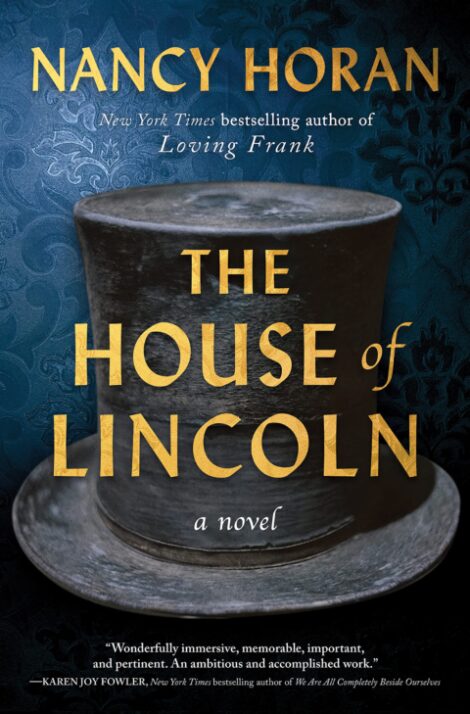
THE HOUSE OF LINCOLN
Nancy Horan, author of the million-copy New York Times bestseller Loving Frank, returns with a sweeping historical novel, which tells the story of Abraham Lincoln’s ascendance from rumpled lawyer to U.S. president to the Great Emancipator through the eyes of a young asylum-seeker who arrives in Lincoln’s home of Springfield from Madeira, Portugal.
Showing intelligence beyond society’s expectations, fourteen-year-old Ana Ferreira lands a job in the Lincoln household assisting Mary Lincoln with their boys and with the hostess duties borne by the wife of a rising political star. Ana bears witness to the evolution of Lincoln’s views on equality and the Union and observes in full complexity the psyche and pain of his bold,
Nancy Horan, author of the million-copy New York Times bestseller Loving Frank, returns with a sweeping historical novel, which tells the story of Abraham Lincoln’s ascendance from rumpled lawyer to U.S. president to the Great Emancipator through the eyes of a young asylum-seeker who arrives in Lincoln’s home of Springfield from Madeira, Portugal.
Showing intelligence beyond society’s expectations, fourteen-year-old Ana Ferreira lands a job in the Lincoln household assisting Mary Lincoln with their boys and with the hostess duties borne by the wife of a rising political star. Ana bears witness to the evolution of Lincoln’s views on equality and the Union and observes in full complexity the psyche and pain of his bold, polarizing wife, Mary.
Along with her African American friend Cal, Ana encounters the presence of the underground railroad in town and experiences personally how slavery is tearing apart her adopted country. Culminating in an eyewitness account of the little-known Springfield race riot of 1908, The House of Lincoln takes readers on a journey through the historic changes that reshaped America and that continue to reverberate today.
- Sourcebooks Landmark
- Paperback
- June 2023
- 352 Pages
- 9781728282114
Buy the Book
$27.99

About Nancy Horan
Nancy Horan is the New York Times bestselling author of Loving Frank and Under the Wide and Starry Sky. Loving Frank remained on the NYT list for over a year, has been translated into sixteen languages and received the 2009 Prize for Historical Fiction. A native Midwesterner, Horan was a teacher and journalist before turning to fiction. She lived for 25 years in Oak Park, Illinois, where she raised her two sons, and she now lives with her husband on an island in Puget Sound.
Praise
“What a gift Nancy Horan has for conjuring the past and bringing it vividly to life! Here, she turns her considerable talents to Lincoln’s strange road to the White House and the turbulence of his presidency, illuminating lesser-known perspectives and details that resonate eerily with our contemporary times. This is top-quality literary time-travel, and the trip is well worth taking.” — Therese Fowler, New York Times bestselling author of A Well-Behaved Woman
“The book’s greatest strength is its unexpected examination of racism in central Illinois, a state long associated with both the Underground Railroad and the Union…Horan has succeeded in illuminating an underconsidered segment of American history. By adding nuance to the history of Illinois in the years surrounding the Civil War, Horan foregrounds the era’s complexity.” — Kirkus Reviews
“The gifted Nancy Horan once again brings readers into a story — inspired by real events — that will forever change the way they perceive famous historical figures and their times. In the captivating and important The House of Lincoln, the young Portuguese immigrant Ana is hired to help in the Springfield, Illinois home of Abraham Lincoln as the Great Emancipator is on the rise. Through Ana’s relationship with Lincoln’s wife Mary and her close friendship with Cal, a free Black girl, the novel explores a lesser-known aspect of a crucial historical period.” — Marie Benedict, New York Times bestselling author of The Only Woman in the Room
“Nancy Horan’s nuanced portrait of Abraham Lincoln as his thoughts on emancipation evolve and her deft, revelatory use of narrators from marginalized communities enhance this compelling, beautifully crafted novel. The House of Lincoln evokes the past to illuminate the present as only the very best historical fiction can.” — Jennifer Chiaverini, New York Times bestselling author of Mrs. Lincoln’s Sisters
“This is a compelling reminder that events of the past are indelibly connected to attitudes that persist today.” — Booklist
Discussion Questions
1. Ana arrives in Springfield as an outsider, both as an immigrant and as a young woman navigating a new culture. How does her status as an outsider shape the way she observes the Lincoln family and the changing nation around her?
2. Throughout the novel, characters are forced to decide when to remain silent and when to speak out against injustice. Which acts of courage—or failures of courage—stood out to you most?
3. The author portrays Abraham Lincoln not as an icon, but as a man whose views evolve over time. How did the novel deepen or complicate your understanding of L Lincoln as both a political leader and a private individual?
4. Discuss the friendship between Ana and Cal. How does their relationship illuminate the racial divisions and social hierarchies of nineteenth-century America?
5. Mary Todd Lincoln is often a controversial historical figure. How did this novel’s portrayal of Mary compare with your previous impressions of her? Did your sympathies toward her change as the story unfolded?
6. The novel highlights the tension between preserving one’s heritage and assimilating into American society. How do different characters negotiate this tension, and what does the novel suggest is gained or lost in the process?
7. The House of Lincoln explores the gap between America’s ideals and its realities. Which moments in the novel most clearly revealed this contradiction?
8. Many historical novels focus primarily on famous figures, yet this book centers the experiences of ordinary people living through extraordinary times. How did this narrative choice affect your reading experience?
9. The Springfield race riot of 1908 serves as a powerful culmination to the story. What impact did this section have on you, and why do you think the author chose to extend the novel beyond Lincoln’s lifetime?
10. What parallels, if any, did you see between the social and political divisions depicted in the novel and issues facing society today? How did those connections influence your experience of the book?