
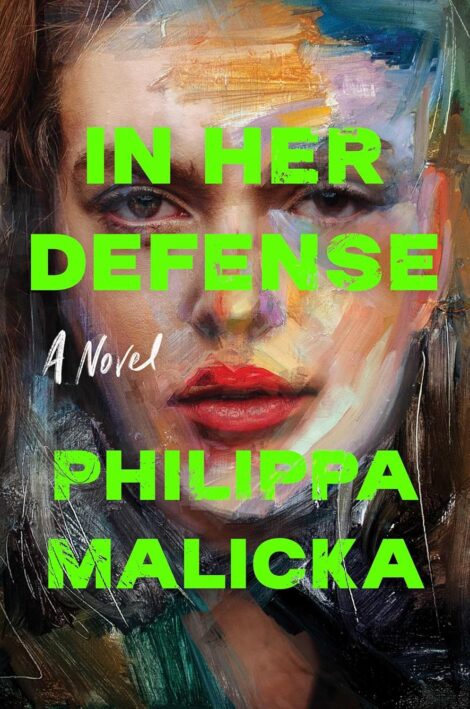
IN HER DEFENSE
As a sensational celebrity libel trial unfolds, a young woman at the periphery secretly wields the power to make or break the case. But with her own hidden past, will she dare to speak up?
Everyone is watching. Only one person knows the truth.
The whole country has been riveted by the trial: Beloved TV star and national treasure Anna Finbow, standing in court, accusing her daughter’s therapist Jean Guest of brainwashing her daughter Mary for her own financial gain. Jean insists Mary’s traumatic memories arise from her upbringing and her time studying at a prestigious art school in Rome;
As a sensational celebrity libel trial unfolds, a young woman at the periphery secretly wields the power to make or break the case. But with her own hidden past, will she dare to speak up?
Everyone is watching. Only one person knows the truth.
The whole country has been riveted by the trial: Beloved TV star and national treasure Anna Finbow, standing in court, accusing her daughter’s therapist Jean Guest of brainwashing her daughter Mary for her own financial gain. Jean insists Mary’s traumatic memories arise from her upbringing and her time studying at a prestigious art school in Rome; wounds only Jean’s therapy can heal. But as the trial unfolds, it’s Augusta “Gus” Bird, Anna’s former employee—a seemingly insignificant bystander, a nobody—who holds the key to unraveling the tangled web of lies and deceit.
What really happened to Mary in Rome? And if her memories can’t be trusted, how will they ever uncover the truth behind her estrangement? Twisty and propulsive, In Her Defense is a compulsively readable debut for fans of Lucy Foley and Laura Dave.
- Scribner
- Hardcover
- February 2026
- 352 Pages
- 9781668033623
Buy the Book
$29.00

About Philippa Malicka
Philippa Malicka was born in Essex and now lives in London. She is an alumnus of the Prose Fiction MA at the University of East Anglia. Her nonfiction has appeared in The Sunday Times (London), The Sunday Telegraph (London), and Grazia among others. In Her Defense is her first novel and has been longlisted for the Bridport First Novel Award.
Praise
“[A] bewitching debut… the crackling story toggles effortlessly from past to present as the depth of the characters’ betrayals and manipulations comes out in open court. This serpentine courtroom drama will captivate readers.” —Publishers Weekly
“Philippa Malicka delivers both a twisting courtroom trial and a haunting character study in this wholly absorbing debut. In Her Defense explores the reliability of memory, the shifting nature of truth, and the fine line between obsession and love. I was completely hooked from the first page to the very last!” —Megan Miranda, New York Times bestselling author of You Belong Here
“A haunting and twisty story of obsession, memory, and the blurred line between healing and harm. Part courtroom drama, part psychological love story, In Her Defense will stay with you long after you’ve turned the final page.” —Liv Constantine, New York Times bestselling author of The Last Mrs. Parrish
“A brilliant, star-making debut—a potent courtroom drama packed with complex characters, deft psychological twists, and buttery prose. The narrator is not so much unreliable as a mystery even to herself, and you’ll be reading way past midnight to solve the puzzle of who she is.” —Julia Heaberlin, bestselling author of We Are All the Same in the Dark
“Smart, elegant, and endlessly unsettling. This is a novel full of delicious, vivid details: the ambiguous characters, the unforgettable settings, the unnerving psychology.” —Abigail Dean, New York Times bestselling author of Girl A
Discussion Questions
RGC Discussion Questions for In Her Defense
1. So many characters in In Her Defense are withholding information or hard to fully trust. Which character did you sympathize with the most as you read, and why? Did your sympathies shift over time?
2. The novel is filled with images of being lost, misplaced, or removed from the world. One of the epigraphs is from Emily Berry’s Ghost Dance:
“People can be removed from the world // They don’t tell you that, but it’s true.”
How did this resonate with you as you read? Who in the book feels like they become “removed”? In what ways?
3. What did you think of the book’s structure? The courtroom scenes are in the present tense mixed with flashbacks to Rome and Anna’s house in Stoke? How did this effect how you pieced together the story? Did it cause you to reassess what you thought you knew as you continued reading?
4. Gus presents herself as thoughtful and observant, yet she increasingly feels like an unreliable narrator. Even when we hear other people’s voices through her memories or in court, we are still receiving everything through her lens. How did that impact what you thought of the other characters? Did you accept Gus’s observations as true? At what point, if any, did you stop trusting her version of events?
5. The idea of predator and prey is a common relationship dynamic throughout the book – both physically (Law) and psychologically (Jean). Does the book suggest that everyone is implicated in this system in some way? Were there any characters who seemed free of these roles?
6. Mary says she finally feels she has power over Law now that she is older, and Gus feels like she finally has power over Jean during the court case. What did you make of that distinction between power and revenge? Does the novel suggest that one connects to or leads to the other?
7. Art is everywhere in the book (Mary painting Gus, Gus acting as a sculptor, Anna as a famous potter, the art schools, and even the courtroom sketch artist). What does art represent in this novel: control, intimacy, exposure, escape, or something else?
8. Mary paints Gus. Gus watches Mary. Gus watches the chat rooms. Law watches girls. Jean watches girls. Gus watches the court proceedings. How does the act of looking function in this novel? When does observation become exploitation? Is there ever a form of looking that feels safe or ethical?
9. What did you think of Gus’s decision to lie on the stand to protect Mary rather than tell the truth and potentially see Jean found guilty? She believes her choice is more likely to keep Mary safe. How does the novel complicate the idea of protection?
10. At the end of the novel, Gus shares the audio file with Lucy. What do you think her intention is? Is she seeking attention, trying to help, attempting to justify her own actions, or some combination of all three? Do you think the novel wants us to know her motive, or to sit with the ambiguity?
11. Gus lies to Mary in the chat room about who she is. Why is she still lying at this point? What do you think she was expecting or hoping to happen by asking to meet? What does this say about whether she has changed – or whether she can be trusted? How do these actions differ from similar actions from Jean, if at all?
12. Why can’t Gus focus on Thea and her own art and move forward with her life? She wasn’t one of Law’s victims, yet she remains deeply invested in the chat rooms and the case. She wasn’t an art student at Mary’s school yet she attends the reunion exhibit. Is this about guilt, proximity to harm, a desire for relevance, or something else entirely?