
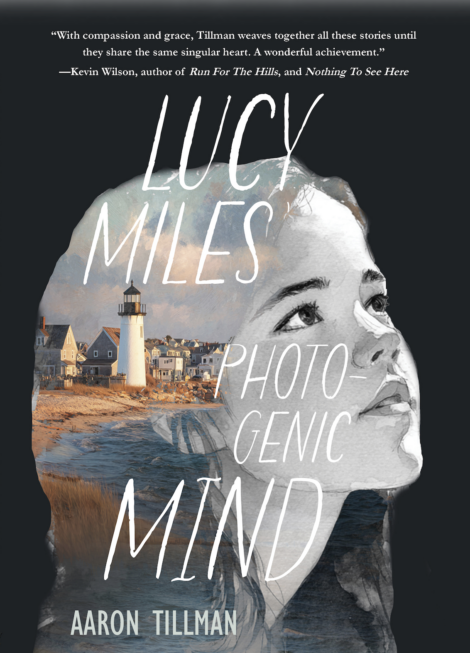
LUCY MILES’ PHOTOGENIC MIND
A literary mystery with a magical realist element, LUCY MILES’ PHOTOGENIC MIND brings together a teenaged boy, a suspended Boston cop, and a Cape Cod snack-shack owner as they search for their extraordinary friend Lucy who disappears in a cloud of suspicion after her estranged mother and emotionally abusive father are murdered.
Kevin Wilson, author of Nothing to See Here and The Family Fang, calls LUCY MILES’ PHOTOGENIC MIND “an amazing blend of seemingly disparate elements…. There is a tenderness and humor for the characters that recalls John Irving,
A literary mystery with a magical realist element, LUCY MILES’ PHOTOGENIC MIND brings together a teenaged boy, a suspended Boston cop, and a Cape Cod snack-shack owner as they search for their extraordinary friend Lucy who disappears in a cloud of suspicion after her estranged mother and emotionally abusive father are murdered.
Kevin Wilson, author of Nothing to See Here and The Family Fang, calls LUCY MILES’ PHOTOGENIC MIND “an amazing blend of seemingly disparate elements…. There is a tenderness and humor for the characters that recalls John Irving, a mystery that binds unlikely characters together, and a touch of magic that reminds me of Hannah Tinti.”
Fifteen-year-old Pinky Green has always felt destined for ridicule, until Lucy Miles shows up and flips his world upside down. Lucy is extraordinary, artistic, and hiding dangerous secrets about herself and her father. When her estranged mother washes up on Calamity Beach and her father turns up dead the next day, Lucy disappears, and everyone points the finger at her.
Determined to help, Pinky teams up with an unlikely crew: Gilda Montgomery, the sharp-tongued owner of Cockaroost Concessions, and Walter Walsh, Lucy’s burly, melancholic godfather and recently suspended Boston cop. As they follow a trail of mysteries both magical and mortal, they confront the complexities of loyalty, the power of friendship, and the strange, luminous truths hidden in the most unexpected places.
- Regal House Publishing
- Paperback
- November 2026
- 278 Pages
- 9781646037957
Buy the Book
$20.95

About Aaron Tillman
 Aaron Tillman is Associate Director of the Writing Program at the University of Massachusetts Amherst. Along with his debut novel, Lucy Miles’ Photogenic Mind (Regal House Publishing, Nov. 17, 2026), he is the author of two short story collections, Consolation Miracles (2022) and Every Single Bone in My Brain (2017), and a book of critical nonfiction,Magical American Jew (2018). He received the Gival Press Short Story Award, the John Gardner Memorial Prize in Fiction, a Short Story Award for New Writers, and several of his stories have been nominated for the Pushcart Prize. His fiction has appeared in Mississippi Review, Pembroke Magazine, Narrative Magazine, Harpur Palate, upstreet, Glimmer Train Stories, Sou’wester, The Madison Review, and elsewhere. He has recorded stories for radio broadcast, and his essays and reviews have appeared in The Writer’s Chronicle, Colorado Review, Studies in American Humor, Symbolism, The CEA Critic, and The Intersection of Fantasy and Native America. He can be found online at aarontillmanfiction.com
Praise
Lucy Miles’ Photogenic Mind is an amazing blend of seemingly disparate elements, and it’s a testament to Aaron Tillman’s imagination that it comes together so beautifully. There is a tenderness and humor for the characters that recalls John Irving, a mystery that binds unlikely characters together, and a touch of magic that reminds me of Hannah Tinti. With compassion and grace, Tillman weaves together all these stories until they share the same singular heart. A wonderful achievement. —Kevin Wilson, author of RUN FOR THE HILLS, NOTHING TO SEE HERE, and THE FAMILY FANG
“Entering the world of Lucy Miles was like no other. Aaron Tillman has created a fascinating character with gifts that surprised and delighted me, along with a community that supported her despite all odds. Be prepared to look up several devices that seem real and might become real in the very near future that are key to unraveling the mystery at the heart of this wonderfully complex novel about friendship, family, and a past that is not what you think it is.” —Jimin Han, author of DREAMT I FOUND YOU and THE APOLOGY
“A perfect blend of tragedy and heart, Lucy Miles’ Photogenic Mind is a beautiful exploration of friendship and connection in the face of chaos. Tillman’s writing is layered with insight and levity that make it an excellent read for anyone who loves their mysteries with a dash of magic (think Stephen King’s The Institute). With satisfying twists and a cast of characters that will make you laugh, scream, and everything in between, Lucy Miles’ Photogenic Mind is guaranteed to keep you turning pages well into the night.” —Mandy McHugh, author of IT TAKES MONSTERS and CHLOE CATES IS MISSING
“In Lucy Miles’ Photogenic Mind, Aaron Tillman spins a mysterious, tremendously imaginative, and genuinely original tale. Artfully and skillfully blending and bending genres, Tillman explores profound questions about loyalty, friendship, memory, secrecy, and betrayal. Lyrical, pitch-perfect prose makes this novel a vivid, poignant, and often humorous read. Lucy Miles’ Photogenic Mind disproves the old adage that ‘there’s nothing new under the sun.'” —Janice Eidus, author of THE LAST JEWISH VIRGIN and THE WAR OF THE ROSENS
“What do the shortest kid in school, a girl with an uncanny eye for photography, a burly cop on informal leave from the force, and the wise-cracking owner of a store called Cockaroost Concessions have in common? They’re all in Aaron Tillman’s novel, Lucy Miles’ Photogenic Mind, a skillful blend of light fantasy and suspect reality that turns into a thriller as the connections start to amass like sea wrack on the Cape Cod shore—all observed through eyes that see everything, down to the smallest detail. Need I mention that the novel’s also darned funny? Lucy Miles is an all-around great read.” —David Galef, author of WHERE I WENT WRONG and BREVITY: A FLASH FICTION HANDBOOK
Discussion Questions
Questions on the structure and style of the novel:
- The novel incorporates different points of view, including Pinky’s first-person POV, Lucy’s journal entries, and a third-person POV that focuses primarily on Walter Walsh the suspended Boston police detective. What do the different narrative perspectives add to the story? Were they ever confusing?
- What did you make of the magical realist aspect of the novel? Were Lucy’s supernatural abilities presented as a natural part of the story? Did they add to your interest in the story or compromise your ability to buy in and feel invested?
- Did the humor make the story more interesting, or did it undermine the more serious circumstances in any way? Which characters or scenes were the funniest for you?
- The novel incorporates multiple genres and modes; it could be characterized as literary fiction, a mystery and suspense novel, a work of magical realism, or even a literary comedy. Do these different modes blend well into a cohesive narrative, or do they leave you wanting more of one genre or another?
- The novel incorporates conventions of the mystery genre—including disappearance, drugs, murder, and a central character who is a police detective (Walter Walsh)—but it is not a police procedural, and Walter remains a flawed human character. Would you have preferred more details about the inner workings of a police investigation, or did the focus on the collaborative, civilian efforts of Pinky, Gilda, and Walter provide enough critical inquiry to propel the story in an authentic way?
Questions on specific characters in the novel:
- At the beginning of the novel, Pinky says that his “whole perspective on the great wide world and all its possibilities and potential…changed fairly radically” when he met Lucy Miles. In what ways did Pinky change after meeting Lucy? What are things he says or does that illustrate that change?
- Deirdre and Sal are both important but contrasting characters who loom large in Walter’s life. How do each of them influence Walter’s actions? What roles do Deirdre and Sal play in the novel’s outcome? Do you think they could ever get along?
- Gilda’s snack shack, Cockaroost Concessions, was named after a horse, and she has horses framed around her store. What is the significance of horses in Gilda’s life? What aspects of her personality and perspective were informed by the Cockaroost Shalimar and Richard, the man who ran the horse farm when she was a child?
- At one time, prior to his discovery of Lucy’s extraordinary ability, Rudy Miles was a talented photographer with a successful business. What contributed to the downfall of Rudy’s business and confidence? What else could he have done other than exploit his daughter’s unique talents?
- Pinky’s cousin Brandon is a bully and a victim. What are some examples that illustrate these contrasting characterizations? Did you find Brandon to be a sympathetic character at all? Why do you think his death was so difficult on Pinky?
Questions on the conclusion of the novel:
- At the end of the novel, certain mysteries get resolved while others remain open to interpretation. There is a section in the Epilogue, “Theories and Actualities,” that focuses on the mysteries surrounding Lucy’s mom, Cynthia Konstantine Miles. What is your theory on Cynthia’s disappearance, reemergence, and murder? What details support your perspective?
- At the very end of the novel, Gilda opens the back door of her snack shack and finds a paper crane with the eyes outlined in black. What do you make of her reaction? Where do you think the paper crane came from and what is its significance?