
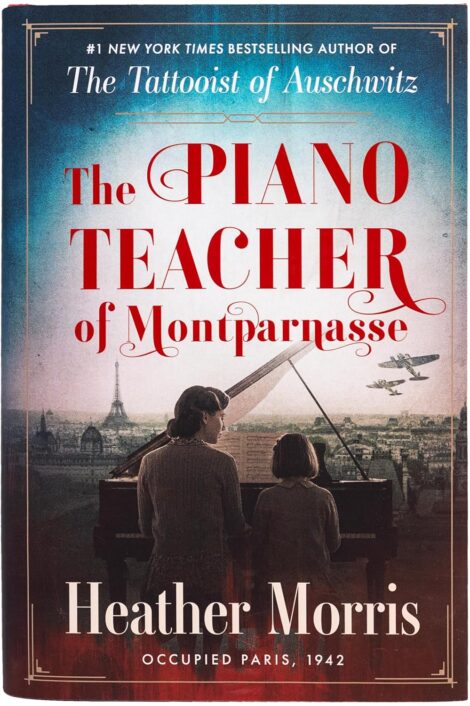
THE PIANO TEACHER OF MONTPARNASSE
The #1 New York Times bestselling author of The Tattooist of Auschwitz returns with a masterful new novel that captures the astonishing bravery of ordinary people in extraordinary times.
In 1942, the Nazis come for a Jewish family living in the Montparnasse area of occupied Paris. In the chaos of their arrest, eleven-year-old Josephine runs to the only person she can trust: her piano teacher, Andrée Levallois, a secret French Resistance operative.
Andrée takes her in as a member of the family, spreading their rations and risking everything to keep her safe.
The #1 New York Times bestselling author of The Tattooist of Auschwitz returns with a masterful new novel that captures the astonishing bravery of ordinary people in extraordinary times.
In 1942, the Nazis come for a Jewish family living in the Montparnasse area of occupied Paris. In the chaos of their arrest, eleven-year-old Josephine runs to the only person she can trust: her piano teacher, Andrée Levallois, a secret French Resistance operative.
Andrée takes her in as a member of the family, spreading their rations and risking everything to keep her safe. But soon the authorities close in, and both Andrée and Josie are caught in a desperate race to stay alive.
Epic in scope and based on real people and historical events, Heather Morris has written a story of breathtaking beauty, at once gripping, heartbreaking, and uplifting.
- Blackstone Publishing
- Hardcover
- October 2026
- 352 Pages
- 9798228808522
Buy the Book
$32.99

About Heather Morris
Heather Morris is a native of New Zealand, now residing in Australia. For several years, while working in a large public hospital in Melbourne, she studied and wrote screenplays. In 2003, she was introduced to a gentleman who had “a story worth telling,” which formed the basis of her first novel, The Tattooist of Auschwitz, and its follow-up, Cilka’s Journey. Her third novel, Three Sisters, concluded the Tattooist trilogy. One of the twenty-first century’s best-selling books, The Tattooist of Auschwitz was made into an acclaimed miniseries in 2024. Heather’s books have sold over nineteen million copies worldwide.
Praise
“Based on a true story, this novel will once again captivate Morris’s readers, who will be deeply invested in Josephine’s struggle not only to survive but also to find hope and peace amid the devastation of Hitler’s war. Readers of Tatiana de Rosnay’s Sarah’s Key and Charles Belfoure’s The Paris Architect will want to add this title to their TBR piles.” —Library Journal
“The Piano Teacher of Montparnasse is an inspiring true story of resilience, hope, and courage.” —Christy Lefteri, internationally bestselling author of The Beekeeper of Aleppo
“The Tattooist of Auschwitz is an extraordinary document. I find it hard to imagine anyone who would not be drawn in, confronted and moved. I would recommend it unreservedly to anyone, whether they’d read a hundred Holocaust stories or none.” —Graeme Simsion, internationally bestselling author of The Rosie Project
“The Tattooist of Auschwitz is the story of hope and survival against incredible odds and the power of love.” —Popsugar
“A remarkable story of survival and how love triumphed in that lawless hell. A phenomenon.” —The Sunday Times on The Tattooist of Auschwitz
Discussion Questions
1. Why do you think the Levallois family agreed to protect Joséphine?
2. Monsieur Dupont, the concierge for Andrée, Louis, and Augustine’s building, is an unexpected hero. How does the novel show that small acts of courage save lives?
3. Madame Évrard was a fierce protector of her Jewish students. How does the novel show how schools and teachers played a key role in resisting the Nazis?
4. The Levallois family struggled to secure a ration card for Joséphine, having to eke out meager rations of dry bread and coffee. What does the book tell you about the material conditions for people living in occupied France at this time?
5. What role does the piano play in the novel, and how does it figure in the characters’ lives? How did Joséphine’s piano lessons give her and the family hope?
6. How does Joséphine’s story compare to World War II stories you are familiar with? Did you know about the French Resistance groups?
7. Madame Durand and Solène attempted to “save” Joséphine through conversion. What do you make of Augustine and Andrée’s response and promise to preserve Joséphine’s faith?
8. “Clair de Lune” is a song of hope and of home in the novel. How does music provide hope in the novel? What is your sound of hope?
9. Cat goes on a high-risk mission to obtain German files. Gypsy serves the German officers at Le Fleuron to gather intelligence. What does this say about the different ways in which people resisted?
10. Dancer confesses to save her son’s life. Do you blame Dancer for betraying the network? Why does Andrée forgive her?
11. Dancer and Philippe celebrate Hanukkah with Joséphine and the Levallois family. How are the Hanukkah celebrations in the novel an act of resistance?
12. What was your overwhelming feeling when you finished the novel? Was it one of hope?
13. Do you see the Levallois family as heroes or as ordinary people?