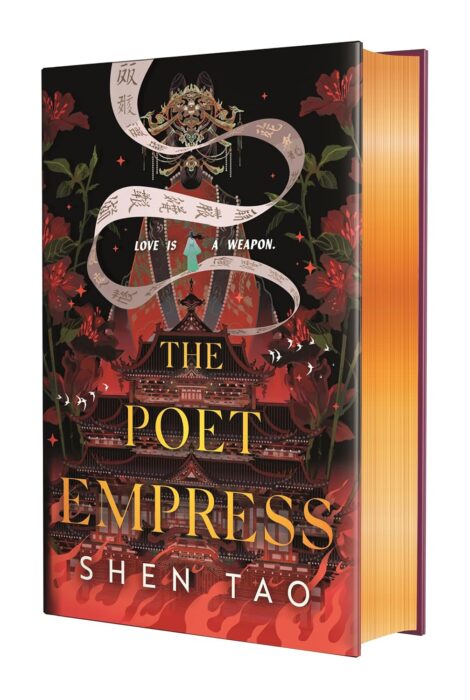
THE POET EMPRESS
A LIBRARY READS PICK!
DELUXE EDITION―featuring gorgeous gilded edges, detailed endpapers, and beautiful case art under the book jacket!
Debut author Shen Tao introduces readers to the lush, deadly world of The Poet Empress, a sweeping, epic and intimate fantasy perfect for fans of The Serpent & the Wings of Night, The Song of Achilles and She Who Became the Sun.
Wei Yin is desperate. After the fifth death of a sibling, with her family and village on the brink of starvation, she will do anything to save those she loves.
A LIBRARY READS PICK!
DELUXE EDITION―featuring gorgeous gilded edges, detailed endpapers, and beautiful case art under the book jacket!
Debut author Shen Tao introduces readers to the lush, deadly world of The Poet Empress, a sweeping, epic and intimate fantasy perfect for fans of The Serpent & the Wings of Night, The Song of Achilles and She Who Became the Sun.
Wei Yin is desperate. After the fifth death of a sibling, with her family and village on the brink of starvation, she will do anything to save those she loves.
Even offer herself as concubine to the cruel, dissolute heir of the blood-gutted Azalea House—where poetry magic is power, but women are forbidden to read.
But in a twist of fate, the palace now stands on the knife-edge of civil war, with Wei trapped in its center. . . with a violent prince.
To save herself and the nation, she must survive the dangers of court, learn to read in secret, and compose the most powerful spell of all. A ballad of love. . . and death.
The Poet Empress is an epic fantasy that explores darker themes, subjects, and scenes that may not be suitable for all readers. Please see the author’s content note at the beginning of the book.
- Bramble
- Hardcover
- January 2026
- 300 Pages
- 9781250406811
Buy the Book
$32.99

About Shen Tao
 Shen Tao immigrated to Canada at an early age, and grew up inspired by both Chinese and Western stories. She has wanted to be a writer for as long as she can remember. The Poet Empress is her first book.
Praise
“Tao’s debut is an intricate study of court politics and what a young woman will do to survive.” —Library Journal, starred review
“The many political threads become fascinatingly tangled, Tao’s prose gleams with poetic precision, and climactic revelations strike with devastating inevitability.” —Publisher’s Weekly, starred review
“Resilient and clever, Wei is the heart of the novel, striving to navigate a world of lies and cruelty without becoming cruel herself. She learns to wield power with fidelity to her purpose, and though the novel’s title alludes to her triumph, the story is full of page-turning suspense.” —Kirkus Review
“With political intrigue as sharp as a blade and sweeping, ethereal prose, The Poet Empress is an astounding debut novel. This mesmerising fantasy shattered and healed my heart in equal measure—and I enjoyed every moment of it.” —Chelsea Abdullah, author of The Stardust Thief
“The very definition of an epic. The Poet Empress draws its world with sharp clarity, its characters with astounding depth, and its magic with flawless precision. Vicious, gorgeous, and fiercely haunting until the end.” —Chloe Gong, New York Times bestselling author of Immortal Longings
Discussion Questions
- The novel begins with the tragic loss of Larkspur. How is Wei able to resist corruption and remain fiercely protective of her family (especially Bao) after leaving her village? How would Terren and Maro have fared if they had been born into Wei’s circumstances?
- In chapter 3, “The Joke of Guishan,” Wei is initially rejected by Ciyi, but she makes a split-second decision to beg to be let into the carriage. If you had been in her situation, would you have accepted rejection as your fate?
- How does Wei reconcile the contradiction of the heart-spirit poem as both a deadly weapon and a poem of love?
- The servants and rulers of Azalea House must contend with continual lies and a lack of evidence to help them discern what is true. What traits are necessary to survive in their world? How do the teachings of Wei’s parents give her an advantage over city girls? How does the clarity of Maro’s diaries compare to the murky rumors about him?
- What did you predict would happen when Wei formed an alliance with Silian? How do both women subvert the patriarchal system that was meant to keep them subservient? In what ways does that system also harm the boys and men it was designed to empower?
- In chapter 69, “The Greatest Nation,” Wei asks whether a nation is worth saving if it cannot keep its own children safe and fed. What can rulers in our contemporary nations learn from Muzha’s dilemma? As he chooses between the invincibility of Terren—whose ruthless violence could restore Tensha’s territory—and the economic schemes of Maro, why is it hard for him to put any hope in a third option, embodied in Isan, of serving the neediest?
- Chapter 18, “Sanctuary,” contains the first of several narrations by Hesin. How does his point of view compare to Wei’s? How did your opinion of him shift as his story unfolded?
- How did you react as the life story of Terren unfolded and the actions of Lady Autumn at the Violet Heron Tower were revealed? Where is the line between explaining cruelty and excusing it?
- Lines of poetry appear in several of the chapter openers and are interwoven with the text. Which of these lines resonated with you? In the novel, what determines whether a literomancer’s message becomes a path for healing or destruction? Do you believe that words can possess magical qualities?
- In the final chapter, how is the spiritual world of the Ancestors fused with the earthly realm? What are the repercussions when humanity loses its connection to the natural world—both in The Poet Empress and in real life?