
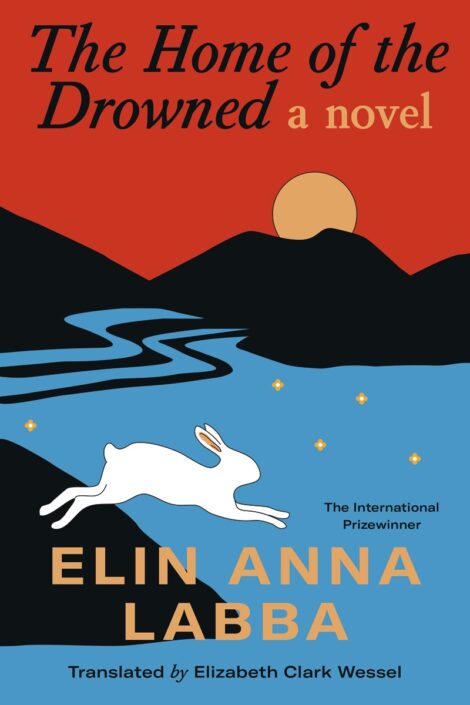
THE HOME OF THE DROWNED
Nothing is true, and everything is true; poetry will never hurt more than what has happened. Every summer, Iŋgá, her mother Rávdná, and her Aunt Ánne travel west to their village on the lake. But the summer Iŋgá is thirteen, they arrive to find their home and possessions have disappeared under water, the land flooded by a dam built to supply hydropower to a society that has continually stolen from them.
The Home of the Drowned follows these women’s fortunes over forty years—from 1942 to 1982—as the water their people have lived near for centuries is transformed into a menacing force that threatens all they hold dear.
Nothing is true, and everything is true; poetry will never hurt more than what has happened. Every summer, Iŋgá, her mother Rávdná, and her Aunt Ánne travel west to their village on the lake. But the summer Iŋgá is thirteen, they arrive to find their home and possessions have disappeared under water, the land flooded by a dam built to supply hydropower to a society that has continually stolen from them.
The Home of the Drowned follows these women’s fortunes over forty years—from 1942 to 1982—as the water their people have lived near for centuries is transformed into a menacing force that threatens all they hold dear. Defying the authorities, Rávdná decides to build a proper house on the lake to replace what was lost, becoming an unlikely activist even as her actions isolate her family from the rest of the community. Meanwhile, Ánne’s health is in decline, and a concerned Iŋgá merely longs to live like everyone else—an impossible wish when the Swedish government is relentlessly drowning her world.
Drawing on her own family’s history of forced relocation and violent colonial dispossession, Elin Anna Labba’s debut novel brings Sámi history to the fore through this intimate story. In poetic prose deftly translated by Elizabeth Clark Wessel, she reveals connections between land, water, and people that hauntingly reverberate with the question: what is it that makes a home?
- University of Minnesota Press
- Hardcover
- June 2026
- 352 Pages
- 9781517918958
Buy the Book
$28.95

About Elin Anna Labba & Elizabeth Clark Wessel (Translator)
 Elin Anna Labba is a Sámi writer and journalist from the arctic region of Sweden. She has worked as an editor for Sámi magazines and as director of Tjállegoahte, the Sámi Writers’ Centre, which is dedicated to promoting Sámi literature. Her first book, The Rocks Will Echo Our Sorrow: The Forced Displacement of the Northern Sámi, also published in translation by the University of Minnesota Press, was awarded Sweden’s 2020 August Prize for Best Nonfiction along with several other prestigious awards. In 2024, Labba was appointed Honorary Doctor of Philosophy at Luleå University of Technology in recognition of her contribution to both literary and public discourse and for giving voice to communities shaped by historical and environmental change. The Swedish publication of The Home of the Drowned was awarded the Norrland Literature Prize in 2025.
Elizabeth Clark Wessel is a poet and translator of numerous books, including The Eighth House by Linda Segtnan, Let’s Hope for the Best by Carolina Setterwall, and What We Owe by Golnaz Hashemzadeh Bonde. Originally from rural Nebraska, she now lives and works in Stockholm, Sweden.
Praise
“Elin Anna Labba’s The Home of the Drowned paints a stunning portrait of the tenacity of an Indigenous people jarred, displaced, and neglected by so-called progress. In spare yet evocative prose, The Home of the Drowned contains not only the indelible story of a Sámi family’s loss and struggle in an encroaching society that is contemptuous of their very existence, but also the deeply affecting relationship between defiant mother Rávdná and her daughter Iŋgá, two generations of Sámi women caught in times of change and adversity. Reading this decades-spanning epic, it’s impossible not to be moved by countless heartbreaking passages describing the land, the Sámi way of life, and Iŋgá and Rávdná’s fraught journey through a hostile world.“—Jon Hickey, author of Big Chief
“The Home of the Drowned is an exultant, elegiac novel about the healing power of home, seen through a community’s experiences in the wake of environmental challenges.” —Foreword Reviews
“Elizabeth Clark Wessel’s English translation from Swedish and Sámi is a delight.” —Full Stop
“A beautiful book written with knowledge and love.“ —Reading Skywards
“This beautifully written debut novel by a Sámi journalist and author from the Arctic region of Sweden is a must-read.” —St. Paul Pioneer Press
Discussion Questions
- How does Elin Anna Labba portray the relationships between Iŋgá, Rávdná and Ánne? What role do grief, love, and care play in their family structure?
- In The Home of the Drowned, loss is about much more than the destruction of a house. What else is lost when a place disappears? How does Elin Anna Labba describe the connection between place, language, memory, and identity?
- The novel grapples with memory – personal, collective, and the memory marked on the landscape itself. How does Elin Anna Labba describe the connection between memory and place? Is it possible for a landscape to have memories as a human does?
- The lake is a character in the novel. How does it contribute to the story that the lake is allowed to speak for itself?
- The construction of the dam is described as the result of progress and modernization, but it entails an immense loss for the people who live in the area. How does the novel handle the concept of progress? Is an equitable form of development even possible, or are incommensurate losses inevitable?
- The novel describes a part of Swedish history that maybe is not so well-known. How did that impact your reading? What parallels can you draw to other historical events in other parts of the world?
- The novel springs from a specific historical event, but it raises questions that are relevant to today. What responsibility does a society have to the people, places, and stories that were sacrificed in the name of progress?
- What scene or image from the novel stayed with you the longest after you were done reading, and why do you think it made such a strong impression?