
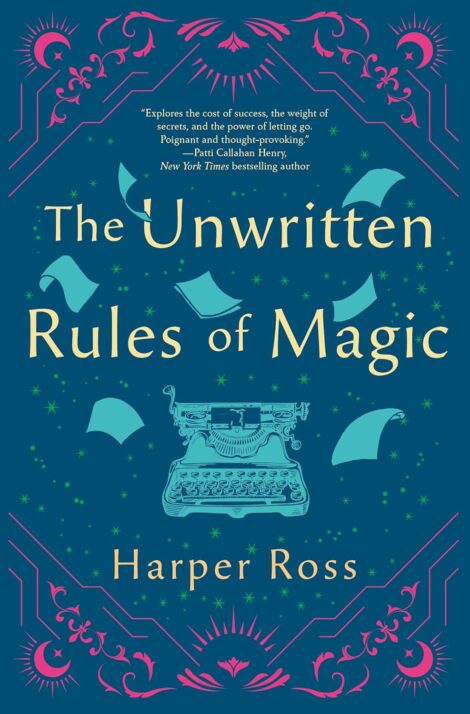
THE UNWRITTEN RULES OF MAGIC
For fans of The Midnight Library and In Five Years, The Unwritten Rules of Magic is a spellbinding novel that blends magic and memory in an unforgettable journey through love, grief, and the hidden cost of perfection across three generations of women.
Emerson Clarke can’t remember a time when she felt in control. Her father—a celebrated author—was a chaotic force until he got Alzheimer’s. Her mother turned to gin. And recently, her teen daughter has shut her out without explanation. If only she could arrange reality the same way she controls the stories she ghostwrites,
For fans of The Midnight Library and In Five Years, The Unwritten Rules of Magic is a spellbinding novel that blends magic and memory in an unforgettable journey through love, grief, and the hidden cost of perfection across three generations of women.
Emerson Clarke can’t remember a time when she felt in control. Her father—a celebrated author—was a chaotic force until he got Alzheimer’s. Her mother turned to gin. And recently, her teen daughter has shut her out without explanation. If only she could arrange reality the same way she controls the stories she ghostwrites, life could be perfect.
Or so she thinks.
After her father’s funeral, Emerson steals his vintage typewriter—the one he’d forbidden anyone to touch—and tests its keys by typing out a frivolous wish. When it comes true the very next day, she tries another. Then, those words also spring to life. Suddenly, she becomes obsessed with using the typewriter to rewrite happiness for herself and her daughter.
But the more she shapes her real-life, the more she uncovers disturbing truths about her family’s history and the unexpected cost of every story-come-true. She should destroy the typewriter, yet when her daughter’s secret finally emerges, Emerson is torn between paying the price for bending fate and embracing the uncertainty of an unscripted life.
- St. Martin's Press
- Hardcover
- January 2026
- 320 Pages
- 9781250394552
Buy the Book
$28.00

About Harper Ross
Harper Ross has enjoyed a lifelong love affair with the dramatic story worlds in books and movies. After leaving her legal practice to raise her kids, she discovered her own creative side and began writing novels that explore friendship, family, and forgiveness. Because she also appreciates the magic in everyday life—from the spark of attraction to those serendipitous moments we all experience—you’ll find a dash of that in her work too. When she’s not at the keyboard, she’s likely to be singing badly in her car, dancing in her kitchen, or walking her adorable dog, Mo. She’s also a lucky wife and mother to a very patient and supportive family.
Praise
“Crisp prose, mature characters, and well-wrought emotional trials propel this introspective journey of self-discovery.” —Publishers Weekly
“This debut novel is a realistic and touching family drama about acceptance, letting go, and moving forward.“ —Booklist
“In The Unwritten Rules of Magic, Harper Ross taps into our deepest, and quite possibly secret, desire to control our own lives and fate through magic. At its heart this story asks us, “Should life be controlled or embraced for its uncertainties?” With vividly drawn characters and evocative imagery, The Unwritten Rules of Magic explores the cost of success, the weight of secrets, and the power of letting go. Poignant, thought-provoking, and cleverly rendered, this novel reminds us that while we can try to write what we believe is our perfect story, life often has other plans.” —Patti Callahan Henry, The NYT Bestselling author of The Secret Book of Flora Lea
“Is it magic or grief? A compelling page-turner about a woman trying to make sense of a world that’s turned upside down. In her confident novel Harper Ross gives us a wise and wonderful book about love, grief, and the magic of hope.” —Barbara O’Neal, author of The Last Letter of Rachel Ellsworth
“Harper Ross’s debut is a master class in family dynamics and my favorite kind of novel—one that’s both deeply nuanced and a delightful read. With bright prose, a cast of deftly drawn characters, and a sprinkling of magic, The Unwritten Rules of Magicis a beautiful story about finding the strength to be vulnerable and the courage to embrace life’s what-ifs with arms wide open.” —Barbara Davis, bestselling author of The Echo of Old Books
Discussion Questions
-
If you had access to a typewriter that made your wishes come true—but at an irreversible hidden cost—would it be worth sacrificing? (Would your answer change if it meant helping someone you love?)
-
Emerson believes she’s never been in control of her life. In what ways has she contributed to her own lack of agency? Where has she demonstrated hidden strength or autonomy?
-
Let’s talk about Emerson’s role as a ghostwriter. How does her professional invisibility mirror her emotional life? What does it mean for her to “write her own story” by the end?
-
As Emerson uncovers how her father used the typewriter to manipulate both her and her mother’s lives, she’s forced to confront her own similar behavior. How does the story explore the tension between love and control? Can trying to “fix” someone’s life ever be an act of love—or is it always a form of control, no matter the outcome?
-
Was Emerson justified in using the typewriter to influence her mother’s sobriety—even though the wish indirectly caused a DUI?
-
Emerson’s mother ultimately claims ownership of her choices, saying, “If I’ve learned anything these past few weeks, it’s that I’m responsible for my choices no matter the circumstances.” Do you agree with this perspective?
-
Is Emerson’s journey one of redemption or awakening—or both? What turning point most significantly alters her understanding of control, love, and autonomy?
-
Should Emerson have pushed her daughter for answers about her mood change and secrecy sooner—or respected her daughter’s need for privacy?
-
Was Emerson’s consideration of using the typewriter to erase a particularly painful memory of her daughter’s an act of love, or a failure to accept reality? What are the moral implications of erasing trauma versus helping someone process it?
-
How does the story explore the illusion of “perfect” lives—particularly in affluent communities—and the personal cost of maintaining that illusion?
-
What does the story suggest about the relationship between memory, identity, and happiness?
-
The story suggests that chasing perfection often means missing the beauty of real, messy life. Do you agree? How does this theme play out in your own experience?
-
In what ways does the novel explore generational trauma, especially around secrets and emotional repression? Do you think Emerson breaks the cycle, or continues it in a new form?
-
How does the book use magical realism to deepen the emotional truths of the story? Would the same story have had the same impact without the magical typewriter?