
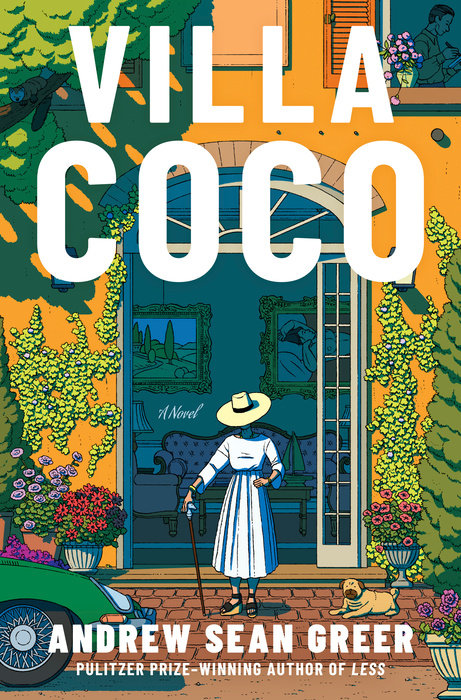
VILLA COCO
An aspiring archivist determined to begin a “serious” life after an undistinguished undergraduate career takes up residence in the Italian countryside. Here, he becomes the all-purpose assistant to the Baronessa, known to her friends as Coco, a defiantly youthful and naturally flamboyant woman of ninety-two. Amid a chaotic and colorful milieu of gin-swilling princesses, incomprehensible handymen, roaming boarhunters, nuns, and other local wildlife, our young man does his best to catalog the villa’s extensive collection of art and antiques—although he notices that things seem to go missing from right under his nose.
Despite himself, he tumbles into an affair with a married man,
An aspiring archivist determined to begin a “serious” life after an undistinguished undergraduate career takes up residence in the Italian countryside. Here, he becomes the all-purpose assistant to the Baronessa, known to her friends as Coco, a defiantly youthful and naturally flamboyant woman of ninety-two. Amid a chaotic and colorful milieu of gin-swilling princesses, incomprehensible handymen, roaming boarhunters, nuns, and other local wildlife, our young man does his best to catalog the villa’s extensive collection of art and antiques—although he notices that things seem to go missing from right under his nose.
Despite himself, he tumbles into an affair with a married man, complicating his future plans considerably. And when the Baronessa loses someone close to her, he becomes an unwitting accomplice in the acceleration of Coco’s great and final plan: to locate the love of her life and be reunited before it’s too late. Told with the signature wit, charm, and humanity that made Less an international phenomenon, Villa Coco is a dazzling, sun-soaked ode to life itself, a meditation on how seriously we ought to take ourselves, and a bawdy Mediterranean ballad about becoming who we’ve always wanted to be.
- Doubleday
- Hardcover
- June 2026
- 288 Pages
- 9780385551977
Buy the Book
$30.00

About Andrew Sean Greer
ANDREW SEAN GREER is the bestselling author of seven previous works of fiction, including the Pulitzer Prize winner Less and its companion, Less Is Lost. He lives in San Francisco and Venice, Italy.
Praise
“[Greer] captures the allure of la dolce vita—Renaissance paintings and books, bottles of Lambrusco wine and gelato—all bathed in a buttery Tuscan light.” —TIME
“Feel[s] like a vacation.” —Vogue
“Witty [and] stylish . . . Villa Coco is all but frescoed with figurative language, and Greer’s seemingly effortless storytelling belies the careful craft of his metaphors and similes. . . . This is a fundamentally pleasant book for unpleasant times, the kind of novel in which a car breaks down and that turns out to be exactly what should have happened. As Greer ultimately suggests, true charm is something you have to try on as you might a dead man’s suit, until what feels counterfeit becomes truly your own. It often begins in fraud and grows into a funny story—sometimes passing, fleetingly, through sorrow on the way. In that regard, the relentlessly charming Villa Coco is its own proof of concept.” —The Atlantic
“[Villa Coco is] packed with warmth, wit, and charm [and a] steady supply of humor. . . . [A] perfect summer cocktail [of a novel].” —The Boston Globe
“What a strange thing. A smart, fizzy novel about how right life can be. In Tuscany! With olive groves! . . . [Villa Coco’s] easygoing warmth gathers into a smile of a coming-of-age tale.” —Chicago Tribune
Discussion Questions
1. From the moment our young man steps off the train in Florence, what transformations does he experience? How is he perceived by those who think of him as Giovedì, the American scholar? In the end, what does he discover about his true self?
2. As you read about Villa Coco’s many treasures, which ones were the most intriguing to you? How would you describe the Baronessa’s curatorial style and her “organizing principles”? In what ways does her storytelling enhance the value of her prized objects? Which of your possessions is the most valuable to you?
3. How did your impressions of Oscar shift as you learned more about artistry, his life, and his history with the Baronessa? What kept her devotion to him aflame for so many decades?
4. Is Pippa shrewd or foolish? Would you enjoy being with her at a dinner party?
5. How does Nimali’s cooking affect our young man? How do the fresh ingredients and mealtime rituals, enhanced by immersion in the seasons of a beautiful landscape, lead to an awakening?
6. When the narrator and Giacomo go on a sojourn to view the Byzantine sites of Ravenna, what common ground do they share? In some ways, does Giacomo have more freedom than the narrator does?
7. Estelle and Ghazel take exceptionally good care of the Baronessa. In the Baronessa’s world, does social rank matter very much? Does she treat royals and servants differently? When the narrator encounters another American caregiver who warns him about becoming entangled in service to a signora (p. 173), were you concerned?
8. The novel features love in many forms, from brief passion to lifelong devotion. What beautiful truths about human nature are revealed in these relationships?
9. The nonfriend Furman Childress (aka Pullman) plays a pivotal role. What were your theories about his significance in the Baronessa’s life? What do you think his ultimate motivations are?
10. In the closing scenes, how does the story of Tetrarch’s toe capture the essence of the Baronessa’s legendary life? What does she teach us about the key to fulfillment?
11. On page 253, did you agree with the narrator’s statement that “they all lived in a sealed world of comic-strip logic, and within that world, all schemes ended as happily as a monkey’s life in Zanzibar”? Where are the lines between comedy and bittersweet tragedy in Villa Coco?
12. How does Villa Coco enhance the humorous yet poignant themes in previous books by Greer that you have read? Would the Baronessa and Arthur Less make good traveling companions?
13. At one point, the Baronessa says, to our narrator but also really to nobody in particular:
“‘We have to choose something,’ she said at last. ‘The wrong choice, maybe, but we have to choose’” (p. 258)? What do you make of that? What would it mean not to choose?