
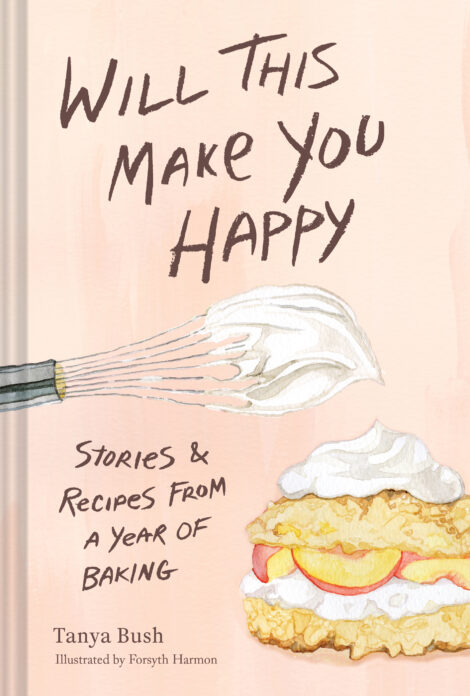
WILL THIS MAKE YOU HAPPY
Stories & Recipes from a Year of Baking
For fans of Nora Ephron and Nigel Slater, this hybrid memoir and cookbook brings together over fifty inventive baking recipes with a lyrical coming-of-age story about desire and dessert. Perfect for home cooks, lovers of literature, and anyone who finds comfort in the kitchen.
Tanya Bush is adrift in the uncertainty of her early twenties—unemployed, uninspired, and stuck in a long-term relationship that’s lost its spark. One day, just to do something, she decides to bake a cake. It’s gooey in the center, woefully underbaked, an absolute disaster—but it also reminds her of the pleasures of baking: sugar crystals under her fingernails,
For fans of Nora Ephron and Nigel Slater, this hybrid memoir and cookbook brings together over fifty inventive baking recipes with a lyrical coming-of-age story about desire and dessert. Perfect for home cooks, lovers of literature, and anyone who finds comfort in the kitchen.
Tanya Bush is adrift in the uncertainty of her early twenties—unemployed, uninspired, and stuck in a long-term relationship that’s lost its spark. One day, just to do something, she decides to bake a cake. It’s gooey in the center, woefully underbaked, an absolute disaster—but it also reminds her of the pleasures of baking: sugar crystals under her fingernails, flour in her hair, and the hard-earned satisfaction of following the steps of a recipe to the end.
Over the course of a year, Tanya embarks on a journey that carries her from her tiny apartment to the sunlit kitchens of an Italian agriturismo to the basement of a bustling Brooklyn bakery, where she rediscovers her appetite for pleasure, indulgence, and meaningful work.
A culinary memoir and love story, interwoven with over fifty innovative and approachable baking recipes, Will This Make You Happy is for readers and bakers looking for something messier, more experimental, and honest than the typical aspirational cookbook.
From the co-founder of the James Beard-nominated literary magazine Cake Zine, pastry chef at Little Egg, and contributing writer for the New York Times T Magazine, this part propulsive and witty coming-of-age story, part baking book is as satisfying to read as it is to cook from. It’s meant to be devoured curled up on the couch or with the mixer whirring in the kitchen.
- Chronicle Books
- Hardcover
- March 2026
- 344 Pages
- 9781797227214
Buy the Book
$29.95

About Tanya Bush & Forsyth Harmon (Illustrator)
 Tanya Bush is a Brooklyn-based writer and baker. She is the co-founder of Cake Zine, the pastry chef for Tables of Contents and the Brooklyn-based restaurant Little Egg. In 2023, her cruller was dubbed NY Mag’s Best Pastry. She is also the author of the forthcoming narrative cookbook Will This Make You Happy. Her writing has appeared in The New York Times, New York Magazine, i-D, Guernica, Eater, Bon Appetit, etc. She has an MFA in creative writing from Hunter College.
Forsyth Harmon is the author and illustrator of Justine. She is also the illustrator of Sweet Nothings by Sarah Perry, the national bestseller Girlhood by Melissa Febos, and The Art of the Affair by Catherine Lacey.
Praise
“Sectioned by seasons, readers are able to bake along with Bush as she recalls the highs and lows of learning new techniques and discovers her culinary voice. The recipes, like Bush’s storytelling, are cheerful and unpretentious, like Blueberry Jam Corn Muffins and Spicy Olive Oil Molasses Ginger Cookies.” ―Food & Wine
“In staking out the premise of this book, called Will This Make You Happy, Ms. Bush took a risky bet: The exact thing you said you didn’t want to wade through before reading a recipe online ― the origin story, or the particular pleasures of a seasonal ingredient, or any obliquely related anecdote from the recipe writer’s life? You actually want more of that. And as someone who is primarily a dessert maker, Ms. Bush is an expert in knowing when people want more of something.” ―The New York Times
“[Bush] charts her aspirations―and her romances, with characters she calls The Boyfriend and The Crush―through the seasons, as she moves from her home kitchen to an ill-fated internship in Italy to her first professional baking gig. […] Recipes for dark-chocolate-and-toasted-coconut cake, soba-cha panna cotta, Concord-grape clafoutis, and other confections punctuate her drifting between listlessness and purpose.” ―The New Yorker
“[…] rich with narrative, following Bush’s whirlwind year shaped by love, disappointment, elation, confusion, and ambition. […] Sprinkled with transformative desserts, the recipes in the book feel practiced and assured.” ―Bon Appetit and Epicurious
“Tanya Bush’s bildungsroman of a cookbook, Will This Make You Happy, traces one high-octane year in her early 20s, as she learns to trust her evolving palate in lieu of chasing simple sugar highs. Her sweet tooth functions as a third eye, propelling her out of a depressive fugue state and into an apron, an internship, a polycule, and eventually, a layered sense of self. Her taste―in cuisine, prose, and affairs of the heart―is a trusty compass readers can cup in their own flour-coated hands.” ―Cultured
Discussion Questions
- In what ways do you feel the narrator changed from beginning to end?
- Did you see this evolution in the recipes as well?
- Which of the recipes did you think was the biggest challenge and/or biggest accomplishment for her in the book?
- How would you have handled the expectation versus reality of the internship in Italy?
- What parallels did you see between the messiness of learning to bake and coming of age?
- What were the mental health themes that you noticed from the narrative?
- How did you see identity as playing a role in the narrative?
- Have you ever had a baking project that didn’t go as planned? How did it turn out in the end?
Essay
Recipe from Will This Make You Happy: Stories & Recipes from a Year of Baking by Tanya Bush, © 2026. Published by Chronicle Books. Photographs by Vanessa Granda. Illustrations by Forsyth Harmon.
Dark Chocolate & Toasted Coconut Birthday Cake
There will be no buttercream in this book. I find it persnickety and overly sweet. Layer cake is an act of balancing flavor—if the base is sugary, as most cakes are, the fillings should introduce tang. Fruit is great for this purpose, but in winter, when fresh berries seem like a distant memory, or I’m sick of citrus, I turn to dairy for an acidic punch: cream cheese, labneh, or sour cream. Rather than relying on my unsteady hand to level the cakes, I bake three layers individually. I use Natasha Pickowicz’s stress-free method for building cakes, constructing the layers in a deep, sturdy cake pan or pot so the layers remain stable. Together, the tender chocolate cake, coconut custard, and dark chocolate cream cheese frosting taste like heaven. The addition of coconut flakes on the exterior adds a pleasing crunch and hides any crumb coat missteps. This base recipe also works beautifully for a single layer cake; just divide the recipe in half and bake it in a 9-inch (23 cm) round cake pan.
MAKES ONE 9-INCH (23 CM) LAYER CAKE
Cakes
240 g (2 cups) all-purpose flour
75 g (1 cup minus 1 Tbsp) Dutch-process cocoa powder
2 tsps baking soda
1 tsp baking powder
11⁄2 tsps kosher salt
240 g (1 cup plus 1 Tbsp) whole milk buttermilk
230 g (scant 1 cup) freshly brewed coffee, cooled
210 g (1 cup minus 1 tsp) light brown sugar
210 g (1 cup plus scant 1 Tbsp) extra-virgin olive oil
200 g (1 cup) granulated sugar
100 g (2 large) eggs, at room temperature
18 g egg yolk (from 1 large egg), at room temperature
1 tsp vanilla extract
Cocoa Cream Cheese Frosting
170 g (3⁄4 cup) heavy cream
450 g (about 1 pound) cream cheese, at room temperature
380 g (31⁄3 cups) powdered sugar
60 g (3⁄4 cup) Dutch-process cocoa powder
1⁄2 tsp vanilla extract
Pinch of kosher salt, or more to taste
400 g (11⁄2 cups) Salty Coconut Custard (see Pastry Cream, below)
Unsweetened coconut flakes, toasted, for decorating
- Preheat the oven to 350°F (180°C). Lightly spritz three 9-inch (23 cm) round cake pans with cooking spray and line the bottoms with parchment paper.
- To make the cakes: In a medium bowl, whisk together the flour, cocoa powder, baking soda, baking powder, and salt.
- In a large bowl, whisk together the buttermilk, coffee, brown sugar, oil, granulated sugar, eggs, egg yolk, and vanilla until smooth.
- In three additions, sift the flour mixture into the wet mixture, whisking vigorously after each addition until the batter is smooth and glossy. Divide the batter evenly among the prepared cake pans, about 510 grams (a little less than 2 cups) per pan.
- Bake until fragrant and the center springs back when touched, 20 to 25 minutes. Let the cakes cool completely in the pans.
- To make the cocoa cream cheese frosting: In the bowl of a stand mixer fitted with the whisk attachment (or in a large bowl with a whisk or handheld mixer), whisk the cream on medium-high speed until stiff peaks form, about 4 minutes. Transfer the whipped cream to a small bowl and place it in the refrigerator.
- In the same bowl of the stand mixer (no need to clean) fitted with the whisk attachment, whisk the cream cheese on medium speed until smooth and fluffy, 1 to 2 minutes.
- Add the powdered sugar and whisk until smooth. Scrape down the sides and bottom of the bowl with a rubber spatula.
- Add the cocoa powder, vanilla, and salt and whisk on low speed until incorporated, stopping to scrape down the sides and bottom of the bowl as needed.
- Using a rubber spatula, little by little, fold in the whipped cream until incorporated. Taste and season with more salt, if desired. Transfer one-quarter of the frosting to a piping bag. Refrigerate all the frosting for 30 minutes.
- Line a deep 9-inch (23 cm) round cake pan or pot with plastic, ensuring plenty of overhang.
- Invert one cake round into the bottom of the prepared cake pan, bottom-side up. Dollop about 100 grams (1⁄3 cup) of frosting onto the cake and spread it evenly with an offset spatula. Pipe a dam of frosting around the perimeter of the cake to ensure the custard doesn’t ooze out of the cake.
- Using an offset spatula, cover the cake evenly with about 200 grams (3⁄4 cup) of the salty coconut custard.
- Invert the second cake onto the custard and repeat with the layer of frosting, the frosting dam, and the coconut custard.
- Finally, place the third cake on top, bottom-side up.
- Wrap the pot tightly in plastic and refrigerate for at least 1 hour or up to 24 hours. Store any unused frosting in an airtight container and refrigerate for up to 4 days. (The cake can also be stored in the freezer, wrapped in plastic, for up to 3 months; thaw the cake in the refrigerator for 24 hours.) Allow the frosting to come to room temperature before use, about 2 hours.
- Invert the cake onto a cardboard cake round or serving platter. Remove the cake pan, then peel off the plastic.
- Spread a thin layer of frosting all over the top and sides of the cake. (This is a crumb coating—you will add more frosting in the next step.) Smooth with an offset spatula and return to the refrigerator for 15 minutes.
- Spread a thick layer of frosting all over the top and sides of the cake. To perfectly smooth the frosting, fill a bowl with hot water and dip the offset spatula into it. Holding the spatula flush to the cake, turn the cake until the coating is smooth.
- Sprinkle the coconut flakes all over the sides and top of the cake. Serve immediately.
Pastry Cream
Custard is the backbone of my baking. I fill cakes and éclairs with it. I serve it as a simple dessert topped with fresh fruit. If I want it to have the texture of a pudding, I loosen it with a few tablespoons of heavy cream or whole milk. My base recipe uses heavy cream and a high proportion of egg yolks so the result is rich and luscious. Custard is miraculous because it comes together on the stovetop, and the flavor is entirely in your control. It is the perfect vehicle for experimenting with flavor. Here I give you my base recipe for the custard I use as a filling: pastry cream. I also offer two variations—tahini and salty coconut. I love the nutty creaminess of sesame in sweet desserts, and when I discovered that dried coconut milk powder is found easily online, I began adding it to almost all of my pastries. You can also sub peanut butter for the tahini, steep tea in the simmering milk, or infuse fresh mint in the cold dairy overnight. I like to eat the custard on its own, or drizzled with a berry compote and sprinkled with the Malty Grape Nut Crunch (page 145) for texture.
MAKES 750 GRAMS (ABOUT 3 CUPS) PASTRY CREAM
350 g (11⁄2 cups minus 1 Tbsp) whole milk, divided
130 g (2/3 cup) granulated sugar
114 g (1⁄2 cup) heavy cream
40 g (5 Tbsps) cornstarch
120 g egg yolks (from 6 large eggs), at room temperature
3 Tbsps unsalted butter, cut into 1⁄2-inch (13 mm) cubes
1 tsp kosher salt, or more to taste
1 tsp vanilla extract or paste
- In a medium pot, combine 227 grams (1 cup minus 1 tablespoon) of the milk, the sugar, and cream. Whisk to dissolve the sugar. Set the pot over medium heat and cook until steaming but not yet boiling, 10 to 12 minutes. Remove from the heat.
- Place the cornstarch in a large bowl. Slowly whisk in the remaining 123 grams (about 1⁄2 cup) milk and the egg yolks until the mixture is smooth.
- Ladle some of the hot milk mixture into the bowl with the yolks, whisking constantly to prevent clumping. Slowly pour the remaining hot milk mixture into the bowl, whisking constantly until smooth. Pour the egg-milk mixture back into the pot and set it over low heat. Cook, whisking constantly and scraping down the sides and bottom of the pot, until very thick, 3 to 4 minutes. Bring to a bubble and cook, whisking constantly, for 1 minute more. Remove from the heat.
- Whisk in the butter until glossy. Stir in the salt, vanilla, and flavoring of your choice (see following variations), if desired, or leave as is. Taste the pastry cream and season with more salt, if desired. (If the pastry cream has lumps, strain it through a fine-mesh sieve set over a large bowl.)
- Let the pastry cream cool completely. Transfer to an airtight container and press a piece of plastic directly against the surface to prevent a skin from forming. Refrigerate for at least 2 hours or up to 5 days.